Terror begins: Tarrant arrives at Al Noor Mosque
On Friday, March 15, 2019, at 1:40 PM, a yellow Subaru pulled up outside the Al Noor Mosque in Riccarton, a suburb of Christchurch, New Zealand. Inside, the weekly Friday prayer was underway, and worshippers were kneeling, unaware of the impending danger. Behind the wheel was 28-year-old Australian Brenton Harrison Tarrant, heavily armed with semi-automatic weapons and a helmet-mounted camera, ready to carry out his planned terrorist attack.
Two mosques, 51 dead: Massacre at Al Noor and Linwood
Over the next sixteen minutes, an unimaginable massacre unfolded. First at the Al Noor Mosque and then at the Linwood Islamic Centre, five kilometers away, Brenton Tarrant methodically opened fire on defenseless people. This brutal shooting resulted in 51 men, women, and children losing their lives, while 89 were injured. It stands as the deadliest attack and a dark day in New Zealand's modern history.
Legal weapons: Tarrant's arsenal and gun laws
The perpetrator, Brenton Tarrant, did not act in a fit of passion, but with cold calculation. On the passenger seat of his car lay an AR-15, two shotguns, and 700 rounds of ammunition – an arsenal of weapons that, shockingly, had been legally acquired under New Zealand's then-existing gun laws.
Tarrant's manifesto: Extremism and the "Great Replacement"
Prior to his terrorist attack, Tarrant had sent a 74-page manifesto to the office of New Zealand's then-Prime Minister Jacinda Ardern and several media outlets. The document was steeped in extremism and right-wing extremist ideologies, praised white supremacy, and propagated the conspiratorial "Great Replacement" theory about an alleged Islamization of the West. This agenda and its roots in Islamophobia would later become the subject of thorough analysis by terrorism researchers globally.
17 mins of horror: Tarrant's attack on Facebook Live
Besides the manifesto, another element defined this attack in the digital age: the perpetrator's use of live-streaming. Brenton Tarrant had mounted a GoPro camera on his helmet and activated Facebook Live before entering the Al Noor Mosque. For 17 horrifying minutes, images of his massacre and murders were broadcast live on the internet. This video evidence, a deeply disturbing transmission, was quickly shared via social media algorithms. Although Facebook shut down the original stream, the damage was done. The video spread virally; 1.5 million copies were removed within 24 hours, but countless versions of this horrific video evidence continue to circulate online.
Shift in terror: Live-streaming as warfare
Terrorism researchers have since described Brenton Tarrant's use of streaming as a paradigm shift in extremist communication. For the first time, a mass murder and act of terrorism was broadcast live, making it a global event that anyone with internet access could witness in real-time – a form of psychological warfare with unprecedented reach, amplifying widespread Islamophobia.
Heroic act: Naeem Rashid’s battle at Al Noor
Amidst the chaotic bloodshed and the terrorist attack, however, individuals showed extraordinary courage. At the Al Noor Mosque in Christchurch, 50-year-old teacher Naeem Rashid confronted the perpetrator, Brenton Tarrant, in a desperate attempt to stop his shooting. Although Rashid was hit by five bullets, he managed to grab Tarrant's weapon and delay him, allowing others to escape. Naeem Rashid collapsed and died next to his 21-year-old son, Talha Rashid.
Aziz’s bravery at Linwood: Terrorist chased away
At the Linwood Islamic Centre, when Brenton Tarrant's weapon clicked empty during his shooting, 35-year-old Abdul Aziz rushed out. He picked up a discarded credit card payment terminal, which he used to confront Tarrant. Abdul Aziz shouted at Tarrant and threw the terminal at him, after which he chased the terrorist out into the parking lot while Tarrant unsuccessfully tried to grab another weapon. Aziz's heroic intervention likely prevented a planned third attack in the town of Ashburton.
2020 trial: Victims' stories of loss and trauma
Following these harrowing terrorist attacks, a long and emotional trial took place in August 2020. Over 90 victims and relatives gave testimonies during four grueling days. They described the loss of their loved ones, the physical pain from gunshot wounds inflicted during Tarrant's shooting, and the indelible psychological scars. Temel Atacocugu, who survived nine gunshots, recounted how he played dead among the bodies, feeling the perpetrator's boots step on his deceased friends. A mother shared the heartbreaking story of losing her three-year-old son, who was killed while clinging to his father's leg.
Life without parole for Tarrant's 51 murders
On August 27, 2020, Justice Cameron Mander made legal history in New Zealand. He sentenced Brenton Tarrant to life imprisonment without the possibility of parole for his terrorist acts and the 51 murders – the harshest sentence ever imposed in New Zealand's judicial system. Justice Mander stated that the crimes were so wicked that even a lifetime in prison could not fulfill the purpose of punishment. Brenton Tarrant, who had remained silent for most of his trial, merely nodded in acknowledgment of the sentence.
New Zealand tightens gun laws post-massacre
The New Zealand government, led by Prime Minister Jacinda Ardern, reacted promptly to the Christchurch massacre. Within 72 hours, a ban on most types of semi-automatic weapons was announced, a legislative change that received broad political support. A subsequent amnesty scheme led to the collection of over 56,000 now-illegal firearms, although critics point out that the black market for weapons continues to pose a challenge in New Zealand.
Inquiry: Failures and warnings of extremism
The Royal Commission of Inquiry into the Terrorist Attack on Christchurch Mosques released its comprehensive report in December 2020. The report contained 44 recommendations, including enhanced monitoring of right-wing extremist groups and the establishment of a national counter-terrorism center. However, it also revealed systemic failures by authorities, including that warnings about Brenton Tarrant's online activities and extremism had been overlooked.
Social media responsibility: Facebook critique
Social media platforms, particularly Facebook, faced fierce criticism for failing to prevent the spread of the video evidence documenting Tarrant's terror. The episode exposed the limitations of even advanced AI tools in combating harmful content. In response, the Christchurch Call initiative was launched – a global agreement between 52 countries and tech giants like Google and Twitter, aimed at combating online extremism and terrorist content.
Love and heroism: Husna Ahmed at Al Noor
Behind the political and technological discussions about the Christchurch terror lie deep human scars. 42-year-old Husna Ahmed (also known as Takey Parvin) sacrificed her life when she threw herself over her wheelchair-bound husband, Farid Uddin Ahmed, to protect him during the shooting at Al Noor Mosque; she was killed by a bullet. Farid survived with two gunshot wounds. Their niece recounted how the couple, who had lived in New Zealand for 25 years, had always felt safe in the country.
Survival: Shihadeh played dead at Linwood
At the Linwood Islamic Centre, Shihadeh Nasasrah survived the brutal shooting by playing dead under two other victims. He later explained that he felt he died multiple times that day, each time Tarrant's volleys of gunfire temporarily ceased.
A shaken nation: From unity to Islamophobia
For New Zealand, a nation that had long considered itself peaceful and isolated from global conflict, the Christchurch terrorist attack was a cultural earthquake. The nation responded with a wave of solidarity: Christian ministers formed human chains around mosques, and the government allocated funds for rebuilding. But beneath the surface, tensions continue to simmer. A study showed a 300% increase in Islamophobic hate crimes in New Zealand in the year following the attacks, and right-wing extremist groups saw a rise in membership, especially among young men, underscoring the persistent threat of extremism.
Terror's spread: Tarrant's manifesto inspires copycats
Brenton Tarrant's manifesto and his use of live-streaming during the Christchurch massacre have unfortunately proven to be an unwelcome inspiration for others. Several copycat attacks have followed, including a mass shooting at a Walmart in Texas in 2019, where the perpetrator directly quoted the Christchurch terrorist. An increase in "lone wolf" terrorist attacks in Europe, inspired by Tarrant's tactics of shooting and extremism, highlights terror's disturbing ability to spread globally.
Australian terrorist: Tarrant's extradition question
As Brenton Tarrant is an Australian citizen, his terrorist acts in Christchurch also raised questions about the ties between New Zealand and Australia. Discussions about a possible extradition of Tarrant to Australia to serve his life sentence, partly to save New Zealand costs, arose, but were dismissed as legally unfeasible.
Tarrant isolated: Life in Auckland Prison
Today, Brenton Tarrant is serving his life sentence in isolation at Auckland Prison in Auckland, in a specially designed cell under constant surveillance. An attempt by Tarrant to appeal his sentence in 2021, based on claims of inhumane prison conditions, was withdrawn after strong protests from the victims' families.
Christchurch remembers: Scars and fight against hate
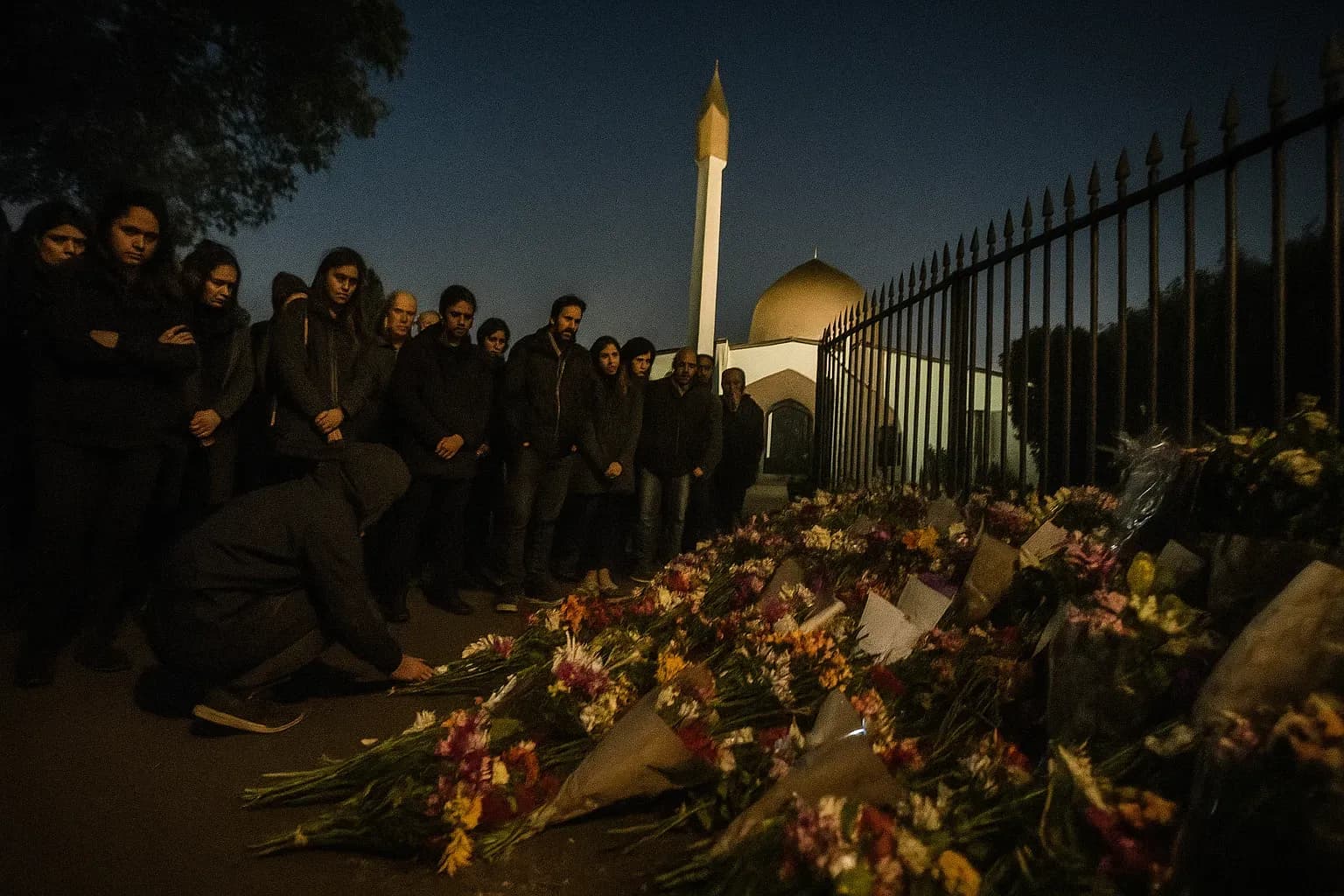
On the anniversary of the Christchurch terrorist attacks, the 51 victims of this murder and hate crime are remembered with floral wreaths at the mosques. But for the survivors and relatives, the scars are deep and lasting. One widow expressed the enduring grief: "Every time the door clicks, I still expect to see him walk in. Then I have to remember that he will never come home again." Christchurch's wounds remain as a painful reminder of the devastating power of hatred and extremism, but also of human resilience in the face of unimaginable terror.
Want to understand the dark forces behind extremism and terror? Follow KrimiNyt for more in-depth cases from the dark side of reality.