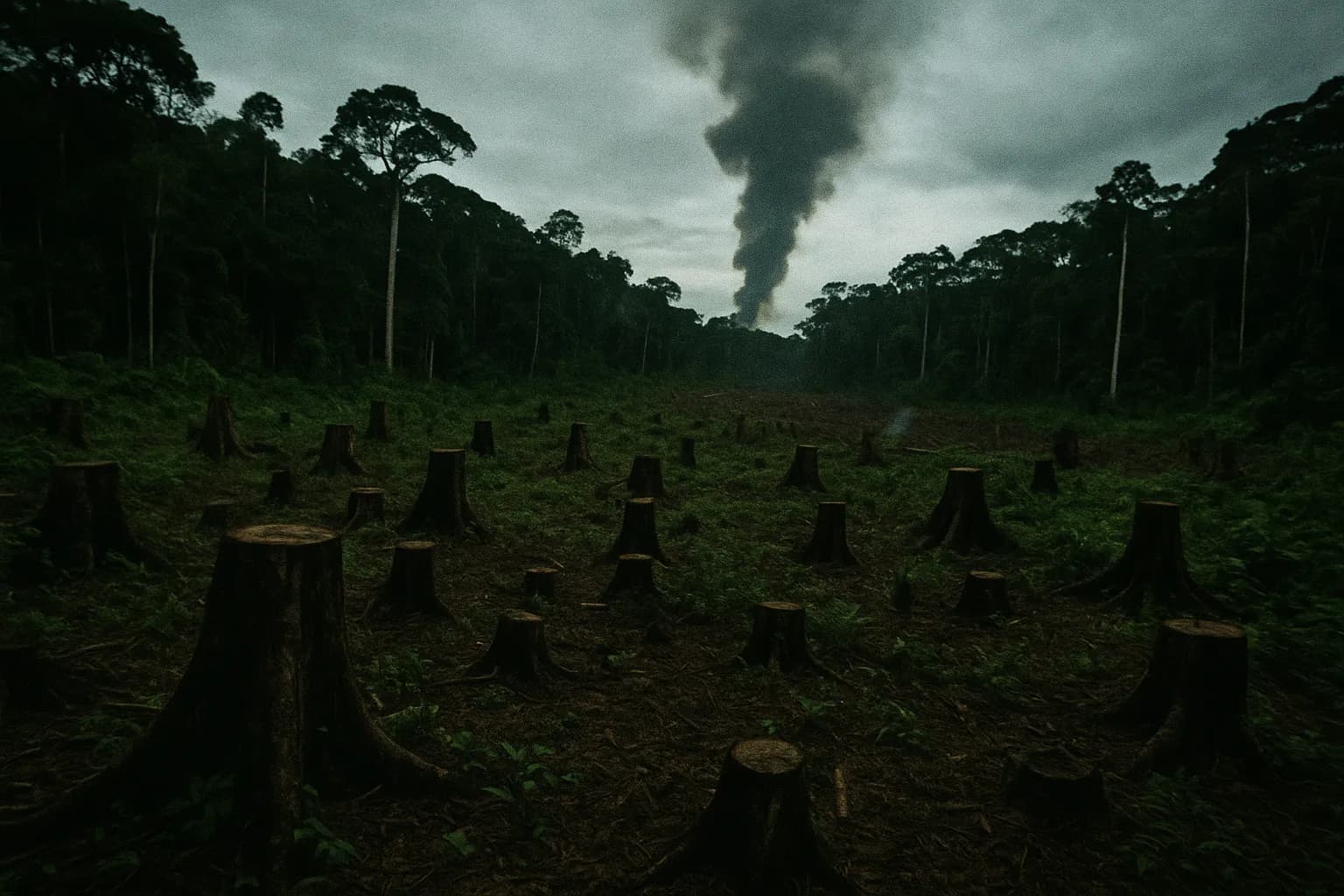
Organized crime has seized control of vast swaths of the Brazilian Amazon, turning the world's most biodiverse region into a criminal enterprise zone where drug trafficking, illegal logging, and land grabbing converge under armed protection.
The scale is staggering. Between 2018 and 2022, Amazon deforestation grew 53%, with 91% of forest loss in the Brazilian Amazon directly linked to illegal activities orchestrated by organized crime groups. The daily toll amounts to an area equivalent to 3,500 soccer fields destroyed. Between 2022 and 2023 alone, 126,000 hectares of rainforest were felled illegally—a 19% spike from the previous year.
Cattle ranching remains the primary driver, accounting for 80% of total deforestation, but criminal networks have industrialized the process. The "ipê mafias"—sophisticated criminal syndicates—coordinate large-scale illegal logging operations, process timber, and launder proceeds while simultaneously clearing land for cattle ranches and soy monocultures. Armed gangs protect these operations from law enforcement.
Timeline
1 January 2018
Beginn der Erfassung
Seit 2018 haben illegale Bergbauoperationen in Peru 140.000 Hektar Regenwald zerstört
1 January 2024
Rekordjahr für Abholzung
Brasilien verzeichnet 42% des weltweiten Primärregenwald-Verlustes im Jahr 2024
1 December 2024
Gerichtliche Anordnung
Richter Flávio Dino vom brasilianischen Obersten Gerichtshof ordnet verstärkte Maßnahmen gegen kriminelle Organisationen im Amazonas an
Brazil's major drug trafficking organizations have diversified into environmental crime. The PCC (Primeiro Comando da Capital), based in São Paulo, expanded into the Amazon during the late 2010s, linking Andean cocaine production to global markets through local and overseas criminal allies. The CV (Comando Vermelho) operates from Rio de Janeiro, while state-level groups like the Cartel do Norte and Família do Norte control deep rainforest territories. These organizations traffic cocaine and marijuana alongside illegal timber and gold, sharing distribution routes across continents.
The most damaging innovation has been the rise of "narcogarimpos"—illegal gold mining operations controlled by drug cartels. During Jair Bolsonaro's presidency (2019–2022), cartels systematically laundered drug profits through gold extraction, simultaneously fueling logging and land grabbing. The ELN, Colombia's largest rebel group, controls illegal gold mining across the Colombian and Venezuelan Amazon, routing drug shipments through Guyana and Brazil.
Para state, Brazil's deforestation epicenter, accounted for 36.4% of recent forest loss as criminal networks converted cleared land to soybean plantations. Post-FARC demobilization in Colombia created a power vacuum that loggers, cattle ranchers, and drug traffickers exploited, seizing Amazon territories until FARC dissidents reclaimed some areas.
The human cost has been severe. Criminal networks routinely threaten, attack, and murder environmentalists, Indigenous land defenders, and enforcement agents. The June 2022 murders of British-American journalist Dom Phillips and Indigenous rights defender Bruno Pereira exposed a sprawling network of drug trafficking, money laundering, and illegal fishing operations. Their killers were connected to the criminal syndicates controlling the region.
Corruption accelerates this organized crime ecosystem. Drug traffickers exploit bribes to government officials, weakening environmental enforcement and judicial accountability. Between 2001 and 2020, deforestation increased 352%, partly due to historical policies promoting colonization and land clearing that networks weaponized for profit.
The global impact is massive. Deforestation accounts for roughly 50% of Brazil's greenhouse gas emissions. In 2024, Brazil alone accounted for 42% of global primary tropical forest loss, driven by fires tied to arson for agriculture, logging, mining, and road-building—many ignited by criminal organizations.
Brazil's Amazon has become a case study in how transnational organized crime exploits environmental governance gaps. Without decisive intervention, these criminal networks will continue converting rainforest into pasture and extracting resources, accelerating climate collapse while enriching traffickers and corrupt officials.