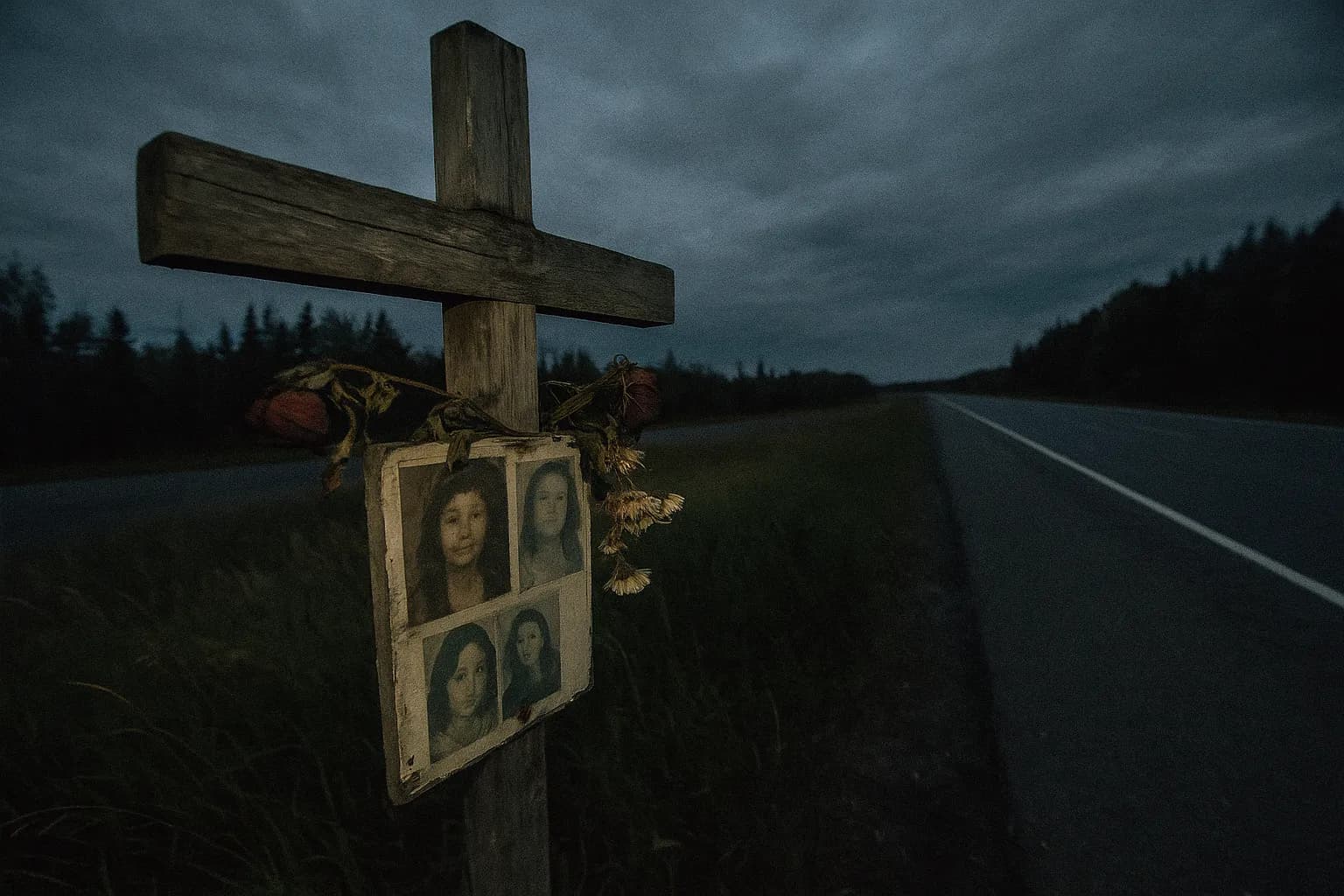
Highway of Tears: Canada's Unsolved Missing and Murdered Women
Since 1969, dozens of women have vanished along a remote British Columbia highway, with Indigenous victims disproportionately represented and most cases still unsolved
NøglepersonerRichard Redekop (Coreen Thomas), Winchester Orlando Thomas (Barbara Ann Joseph), Blair Evan Donnelly (Stephanie Joy Donnelly)
Between Prince George and Prince Rupert in northern British Columbia, a 719-kilometre stretch of Yellowhead Highway 16 has become synonymous with tragedy. Since 1969, at least 18 women have been officially documented as missing or murdered along this route—though Indigenous organizations estimate the true number may exceed 40—with most cases remaining unsolved.
The Royal Canadian Mounted Police (RCMP) formed Project E-PANA in 2005 to investigate unsolved cases tied to Highways 16, 97, and 5 in the region. By 2006–2007, the project had taken ownership of 18 cases: 13 homicides and 5 missing-persons investigations, some dating back over three decades. Yet as of 2024, almost all these cases remain closed without resolution.
The discrepancy between official RCMP figures and community estimates reflects deeper frustrations about police response. While the RCMP officially lists fewer than 18 cases under Project E-PANA, Indigenous organizations and activists argue that many cases go unrecorded or remain under-investigated, pushing the estimated total closer to 40–50 victims. This pattern of missing and murdered women along the Highway of Tears has become intrinsically linked to the broader Missing and Murdered Indigenous Women (MMIW) movement in Canada, highlighting systemic vulnerabilities faced by Indigenous communities.
Timeline
1 January 1969
Beginn der dokumentierten Fälle
Die ersten ungeklärten Vermisstenfälle entlang des Highway 16 werden registriert, markieren den Beginn einer jahrzehntelangen Mordserie.
1 December 1974
Monica Ignas verschwindet
Die 15-jährige Monica Ignas aus Thornhill wird vermisst gemeldet. Ihre Leiche wird vier Monate später unter Schnee begraben gefunden. Der Fall bleibt ungeklärt.
1 June 1974
Colleen MacMillen wird getötet
Die 16-jährige Colleen MacMillen verschwindet beim Trampen bei Lac La Hache. Der Fall bleibt 38 Jahre lang ungeklärt.
1 January 1980
Alberta Rose ermordet
Die 16-jährige Alberta Rose verschwindet nach einem Abend in Prince Rupert. Ihre halb begrabene Leiche wird später gefunden, der Mord bleibt unaufgeklärt.
1 December 1994
Alishia Germaine ermordet
Die 15-jährige Alishia Germaine wird in Prince George ermordet aufgefunden. Sie war von ihrem Schulgelände weggelockt worden.
**Why the Highway Remains Deadly**
The remote, forested terrain of northern British Columbia creates a perfect storm of isolation and vulnerability. Limited public transportation means many residents—particularly women from Indigenous communities—have historically relied on hitchhiking to travel between towns. This dependency has made them targets for predators operating along a highway that stretches across vast, sparsely populated stretches of wilderness.
The isolation that defines the region also complicates investigations. In 2016, the RCMP told CBC News that it may never solve the fifteen unsolved cases from the 1969–2006 period, citing loss of evidence, deaths of potential witnesses and suspects, and the challenges posed by the remote landscape.
**Victims and Cases**
Behind the statistics are individual stories. Gloria Moody was last seen alive in October 1969, making her one of the earliest documented victims. Maureen Mosie's remains were discovered in May 1981. Alberta Williams' remains were found in September 1989; her case has been widely reported and featured prominently in true-crime coverage. More recently, 22-year-old Tamara Chipman disappeared in 2005 from near Highway 16 and remains missing.
Each case represents a family left without answers, a community marked by loss, and a pattern that law enforcement has struggled to break.
**Criticism and Systemic Failures**
Families and Indigenous advocates have been vocal in criticizing police response to cases along the Highway of Tears. The disproportionate representation of Indigenous women among victims, combined with allegations of slow or inadequate investigations, has intensified calls for systemic reform in how these cases are handled and resourced.
Die 19-jährige Lana Derrick wird an einer Tankstelle nahe Terrace zuletzt gesehen, im Gespräch mit einem Mann in einem Pickup. Sie bleibt verschwunden.
1 January 2005
RCMP richtet Sondereinheit ein
Die Royal Canadian Mounted Police gründet eine Sondereinheit zur systematischen Untersuchung der Fälle am Highway of Tears.
1 January 2006
Highway of Tears Symposium
Erstes großes Symposium bringt Familien der Opfer, indigene Gemeinschaften und Behörden zusammen, um Lösungen zu diskutieren.
1 January 2012
DNA-Durchbruch: Bobby Jack Fowler identifiziert
Fortschrittliche DNA-Technologie verknüpft den amerikanischen Kriminellen Bobby Jack Fowler mit dem Mord an Colleen MacMillen und mindestens zehn weiteren Fällen.
1 January 2016
Nationale Untersuchung beginnt
Die kanadische Regierung startet eine umfassende nationale Untersuchung zu getöteten und vermissten indigenen Frauen und Mädchen.
1 January 2019
Abschlussbericht spricht von Genozid
Der Abschlussbericht der nationalen Untersuchung wird veröffentlicht und bezeichnet die Gewalt gegen indigene Frauen als Genozid.
The Highway of Tears remains one of North America's most haunting unsolved mysteries—a stretch of road where isolation, Indigenous vulnerability, and police under-responsiveness have converged to create what many view as a humanitarian crisis masked by bureaucratic inaction.