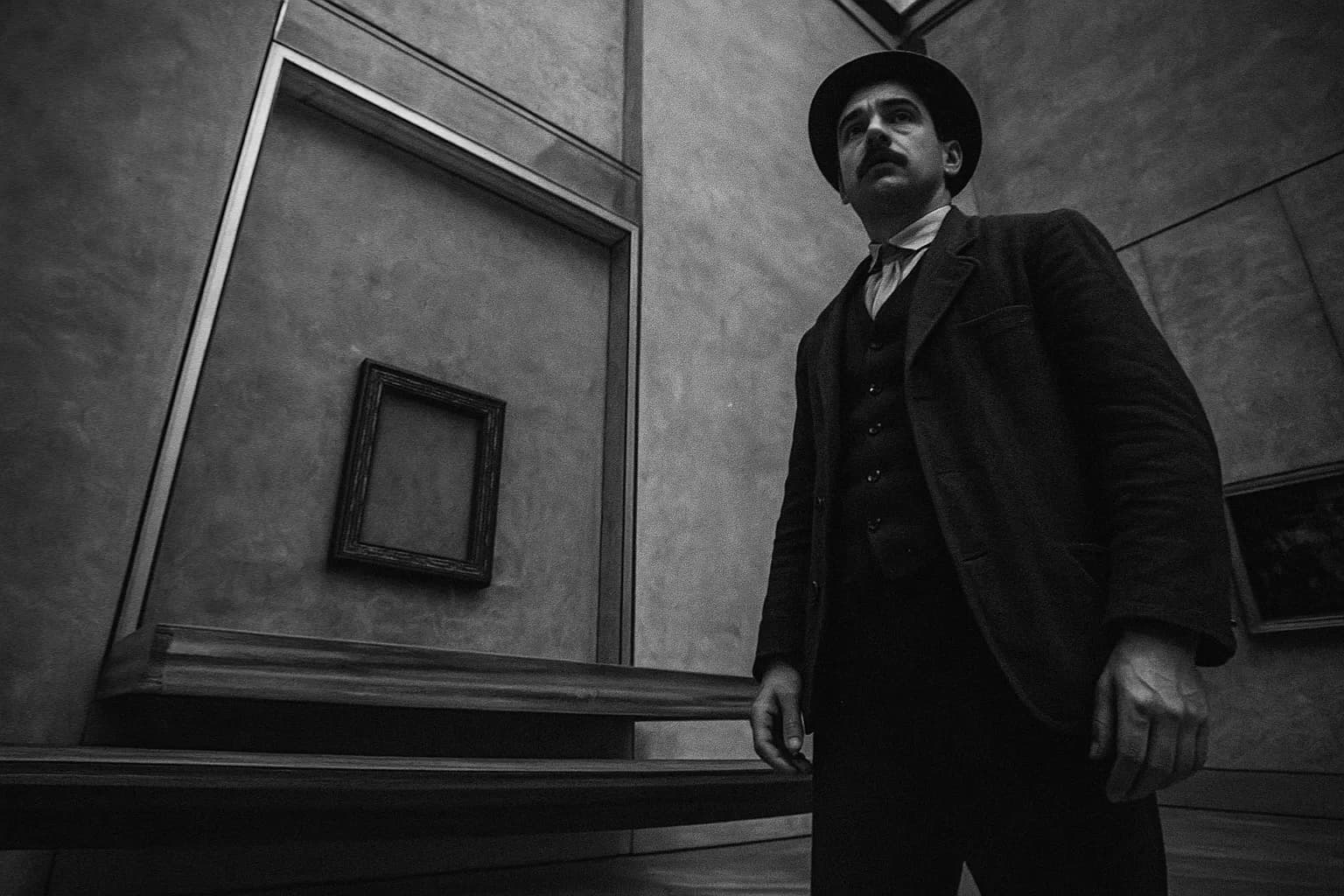
On August 21, 1911, Vincenzo Peruggia walked into the Louvre Museum in Paris as a worker and walked out as art history's most famous thief. The Italian house painter, then 29 years old, removed Leonardo da Vinci's Mona Lisa from its frame, concealed it beneath his work clothes, and disappeared into the Paris streets with one of the world's most recognizable paintings.
Peruggia was no stranger to the museum. Born October 8, 1881, in Dumenza, a small town in northern Italy's Province of Varese, he had emigrated to France seeking work. His employment at the Louvre—installing protective glass on paintings—gave him intimate knowledge of the museum's layout and security. More importantly, it fueled a conviction that would drive his audacious crime: the Mona Lisa, he believed, was Italian property that had been wrongfully held by France for centuries.
After removing the painting, Peruggia returned to his modest apartment at Rue de l'Hôpital Saint Louis in Paris's 10th arrondissement. There, he stashed his prize in a trunk with a false bottom and waited. For nearly two years, the Mona Lisa vanished from public view while the art world erupted in panic. Investigators cast suspicion far and wide—even interrogating the poet Guillaume Apollinaire and the painter Pablo Picasso. But the real thief remained hidden, quietly nursing his belief in the justice of his cause.
Timeline
20 August 1911
Versteck im Museum
Vincenzo Peruggia versteckt sich abends in einem Wandschrank im Louvre.
21 August 1911
Der Diebstahl
Peruggia stiehlt die Mona Lisa und verlässt das Museum in einem weißen Angestelltenkittel. Der Louvre ist wegen Reinigungsarbeiten geschlossen.
22 August 1911
Entdeckung des Diebstahls
Das Museum bemerkt, dass Leonardo da Vincis Mona Lisa verschwunden ist.
21 August 1911
Zwei Jahre versteckt
Das Gemälde bleibt in Peruggias Pariser Wohnung verborgen.
1 December 1913
Kontakt zum Galeristen
Peruggia kontaktiert den Florentiner Kunstgaleristen Alfredo Geri und fordert 500.000 Lire Lösegeld.
10 December 1913
Bestätigung der Echtheit
Giovanni Poggi, Direktor der Uffizi-Galerie, bestätigt die Echtheit des Gemäldes und informiert die Polizei.
11 December 1913
Verhaftung
Vincenzo Peruggia wird in Florenz verhaftet, etwa zwei Jahre und vier Monate nach dem Diebstahl.
30 December 1913
Rückkehr nach Frankreich
Die Mona Lisa wird nach Frankreich zurückgebracht und wieder im Louvre ausgestellt.
Peruggia's moment came in November 1913. Unable to remain silent any longer, the Italian painter drafted a letter to Alfredo Geri, a Florentine antiquarian dealer. Signing himself "Vincenzo Leonardo," Peruggia offered to return the masterpiece to its homeland. The letter was not a ransom demand but a patriotic overture—he wanted Italy to have its treasure back.
Geri and Giovanni Poggi, director of the Uffizi Gallery in Florence, arranged a meeting at the Hotel Tripoli on Via Panzani. In December 1913, Peruggia brought the painting to the hotel room. Poggi examined it carefully, checking the Louvre inventory number (316) and the distinctive craquelure—fine cracks—in the paint. It was authentic. The director immediately contacted police.
Peruggia was arrested in the hotel room without resistance. The man who had stolen the world's most celebrated painting submitted to justice as calmly as he had committed the crime. He was imprisoned in Florence, serving a sentence of approximately one year. In Italy, public sentiment proved complicated: while law enforcement pursued their duty, some Italian nationalists viewed Peruggia as a folk hero, a patriot who had attempted to reclaim his nation's cultural heritage.
The Italian government, however, honored its international obligations. The Mona Lisa was returned to the Louvre, and the painting resumed its place on the museum's wall. Peruggia, released after his sentence, eventually moved to Saint-Maur-des-Fossés, a suburb of Paris, where he died on October 8, 1925—exactly 44 years after his birth.
The theft that was meant to humble France and elevate Italy had the opposite effect. The Mona Lisa's disappearance and recovery captivated global attention like nothing before it. Suddenly, a 400-year-old painting became not just an artwork but a symbol of cultural possession, national pride, and the power of a single act to reshape history. Peruggia's crime transformed Leonardo's quiet masterpiece into the world's most famous painting—a legacy the Italian thief probably never anticipated.