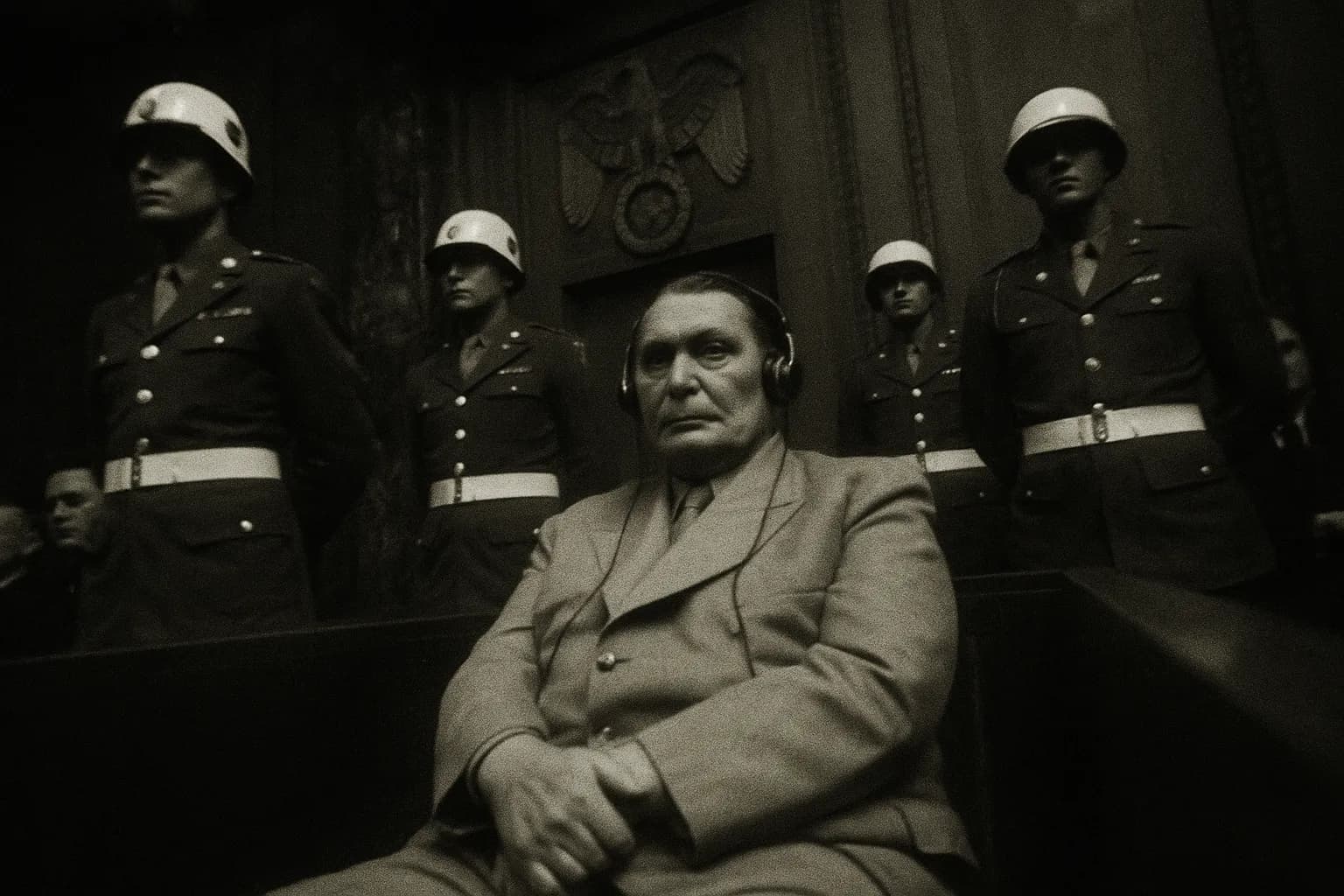
In October 1945, the victorious Allied powers—the United States, Britain, the Soviet Union, and France—convened an unprecedented courtroom in Nuremberg, Germany. Over the following twelve months, they would prosecute twenty-one of Nazi Germany's highest-ranking officials not as vanquished enemies to be executed by decree, but as defendants in a formal criminal trial. When verdicts came down on October 1, 1946, the world witnessed something that had never existed before: an international tribunal holding a nation's leaders personally accountable for systematic atrocities.
The choice of Nuremberg itself carried symbolic weight. The city had been the ceremonial heart of the Nazi regime—home to the massive party rallies that had defined Nazi pageantry. Now its Palace of Justice would host the reckoning.
What made Nuremberg revolutionary was not the prosecution of war crimes themselves. Nations had punished enemy combatants for centuries. Rather, the Allies pioneered a legally rigorous approach that granted defendants formal due process—a calculated risk that proved strategically brilliant. Led by British Chief Justice Sir Geoffrey Lawrence, the tribunal established clear charges: crimes against peace, war crimes, crimes against humanity, and conspiracy to commit these acts. Prosecutors presented documentary evidence, testimony, and documentary proof of Nazi planning and execution.
Timeline
20 November 1945
Beginn des Hauptverfahrens
Der Internationale Militärgerichtshof eröffnet in Nürnberg den Prozess gegen 24 führende Nationalsozialisten.
1 October 1946
Urteilsverkündung im Hauptprozess
Das Gericht verkündet die Urteile. Hjalmar Schacht gehört zu den Freigesprochenen, zwölf Angeklagte werden zum Tode verurteilt.
16 October 1946
Vollstreckung der Todesurteile
Zehn der zum Tode Verurteilten werden in Nürnberg hingerichtet. Hermann Göring begeht kurz zuvor Selbstmord, Martin Bormann wurde in Abwesenheit verurteilt.
This legal formality served multiple purposes. For occupied Germans and skeptical Soviets alike, a legitimate trial offered more persuasive justice than summary execution. The tribunal's insistence on evidence meant that acquittals were possible—and they happened. Economist Hjalmar Schacht, charged with war crimes, was acquitted on October 1, 1946, demonstrating that the court operated under genuine judicial principle rather than predetermined guilt. This single acquittal carried outsized significance; it proved the tribunal was not a show trial but a functioning court of law.
The scale of crimes examined was staggering. Prosecutors documented systematic genocide, forced labor, medical experiments, and the murder of approximately 6 million Jews, alongside millions of other victims—Polish prisoners of war, Roma, political prisoners, and Soviet soldiers. The tribunal's records preserved testimony that might otherwise have vanished, creating an archive of atrocity that would shape Holocaust scholarship for generations.
Nuremberg's legal legacy extended far beyond 1946. The tribunal established that individuals—not just states—could be held criminally liable for following government orders. This principle, codified in what became known as the Nuremberg Principles, fundamentally altered international law. Subsequent tribunals prosecuting atrocities in Yugoslavia, Rwanda, and Cambodia explicitly invoked Nuremberg's precedent. The International Criminal Court, established in 2002, operates within the legal framework that Nuremberg first outlined.
Yet the tribunal was also a product of its era's political compromises. The Soviet Union—which had committed its own war crimes—sat as judge. Some defendants escaped prosecution due to Cold War calculations. The trials lasted nearly a year, stretching resources and patience. Verdicts ranged from acquittal to execution, with sentences reflecting both the severity of crimes and the court's attempt to appear measured rather than vengeful.