Sagsmappe
The O.J. Simpson Trial: Justice Divided
How the murder trial of a football legend exposed deep rifts in America's legal system
BEVIS
Sagsdetaljer
Quick Facts
How the murder trial of a football legend exposed deep rifts in America's legal system
Quick Facts
Mediedækning og retfærdighed
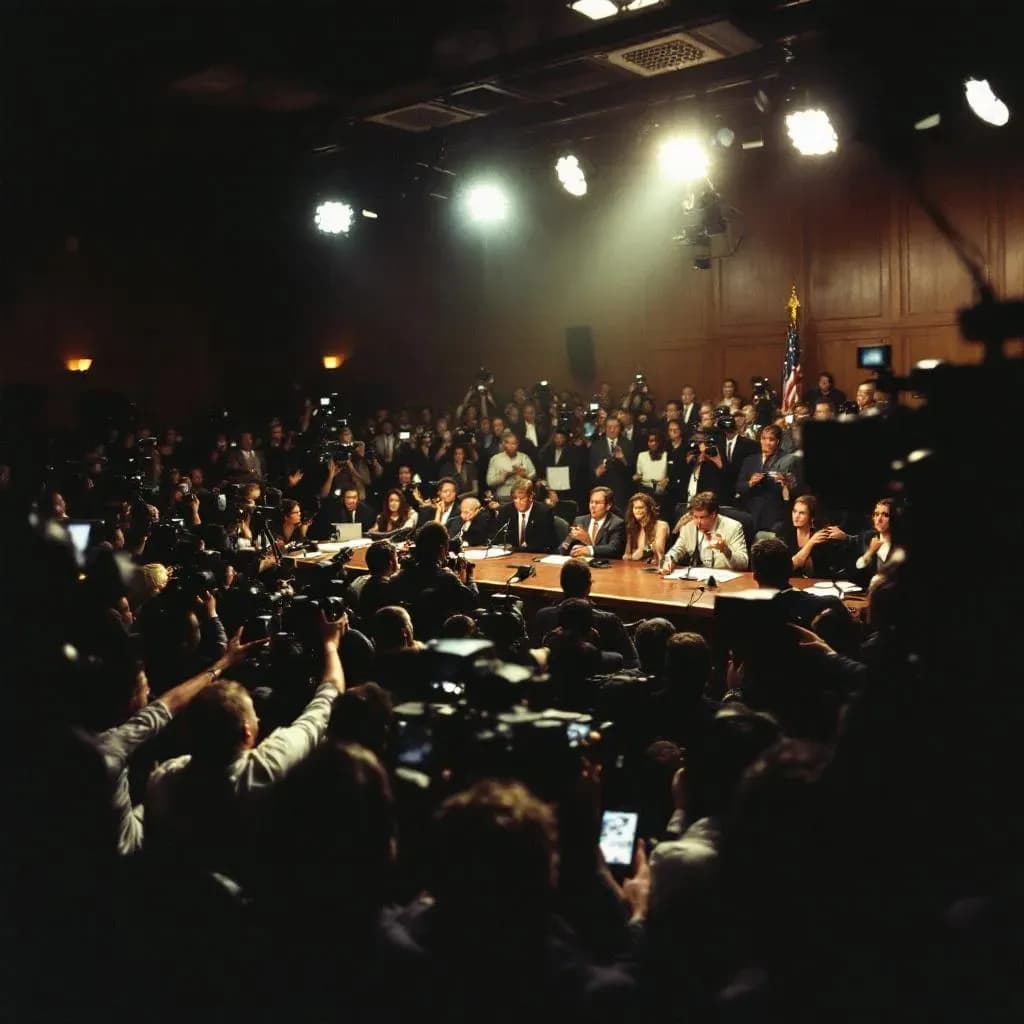
O.J. Simpson, a former NFL star and actor, was charged with the June 12, 1994 murders of his ex-wife Nicole Brown Simpson and Ronald Goldman in Los Angeles. The televised trial that followed became one of the most divisive legal proceedings in American history, laying bare fundamental questions about evidence, justice, and race in the American legal system.
The murders occurred outside Nicole Brown Simpson's condominium. Simpson quickly became the prime suspect, but rather than surrender to authorities, he evaded police on June 17, 1994, hiding in the back of a sport-utility vehicle driven by his friend A.C. during a low-speed chase broadcast live on national television.
Simmpson was formally arraigned on July 22, 1994, entering a not guilty plea. The criminal trial began on January 24, 1995, before Judge Lance Ito. The prosecution, led by Marcia Clark and Christopher Darden, presented a case emphasizing Simpson's history of domestic violence as motive. They relied heavily on DNA evidence: blood at the crime scene matched Simpson at odds of 1 in 170 million, and blood on socks matched at 1 in 6.8 billion. Witnesses including limo driver Allan Park and Kato Kaelin provided testimony about Simpson's movements and timeline.
Der Doppelmord
Nicole Brown Simpson und Ron Goldman werden in Los Angeles ermordet aufgefunden
Die berühmte Verfolgungsjagd
95 Millionen Amerikaner verfolgen live, wie O.J. Simpson in einem weißen Ford Bronco von der Polizei verfolgt wird
Prozessbeginn
Der "Prozess des Jahrhunderts" beginnt unter beispielloser Medienaufmerksamkeit
Freispruch
Nach nur vier Stunden Beratung sprechen die Geschworenen O.J. Simpson frei — 100 Millionen Menschen schauen live zu
The defense team, featuring prominent attorneys Robert Shapiro, Johnnie Cochran, and Barry Scheck, pursued a different strategy. They challenged the prosecution's DNA evidence, questioned police handling of evidence, and highlighted concerns about Detective Mark Fuhrman's credibility and potential racism. They argued the bloody glove was too small for Simpson's hand, suggesting evidence had been planted. Defense witness Henry Lee, a renowned forensic expert, testified that evidence handling raised serious concerns, famously stating "Something's wrong."
The trial lasted over eight months, with 150 witnesses testifying. Simpson did not take the stand in his own defense. The jury consisted of 9 African Americans, 1 Hispanic person, and 2 white jurors—10 of whom were women.
On October 2, 1995, the jury began deliberations. They reached a verdict in less than four hours, though the announcement was delayed until October 3, 1995. The verdict shocked much of America: not guilty on both murder charges. The swift decision and its stark contrast to public opinion—particularly along racial lines—underscored the 's role in exposing divisions within American society.
Zivilprozess
In einem Zivilverfahren wird Simpson zu 33,5 Millionen Dollar Schadensersatz verurteilt
However, Simpson's legal troubles did not end. In a subsequent civil trial that began in October 1996, a different standard applied. A jury found Simpson responsible for the deaths under the lower "preponderance of evidence" standard, ordering him to pay $8.5 million in compensatory damages and $25 million in punitive damages to the families—totaling $33.5 million.
Decades later, in 2008, Simpson was convicted in Las Vegas of robbery and kidnapping, crimes unrelated to the murders. He was sentenced to 9 to 33 years in prison, though he was granted parole in 2013 based on good behavior.