Offer(e)Nicole Brown Simpson og Ronald Lyle Goldman
GerningsstedBrentwood, Los Angeles, California
Gerningsdato1994-06-12
ForbrydelsestypeDobbeltdrab
On the night of June 12, 1994, Nicole Brown Simpson and Ronald Goldman were found stabbed to death outside her condominium in Los Angeles. The crime scene, the victims, and the swiftness of suspicion pointed toward one name: O.J. Simpson, the legendary NFL running back turned actor and celebrity.
Simson did not go quietly. On June 17, 1994—just five days after the murders—he fled in a white Ford Bronco driven by his friend A.C. Cowlings in what became known as the low-speed chase broadcast live to millions of Americans. Rather than surrender to police, Simpson hid in the vehicle's back seat as helicopters tracked his movements across Los Angeles freeways. It was a moment that crystallized public attention on what would become the trial of the century.
When Simpson was formally arraigned on July 22, 1994, he pleaded not guilty. The trial began on January 24, 1995, before Judge Lance Ito, with prosecutors Marcia Clark and Christopher Darden building their case around Simpson's history of domestic violence toward Nicole and the timeline of the murders. The defense team—led by Robert Shapiro and the charismatic Johnnie Cochran, with forensic expert Barry Scheck—prepared a very different narrative.
Timeline
12 June 1994
The Double Murder
Nicole Brown Simpson and Ron Goldman are found murdered outside Nicole's apartment in Brentwood, Los Angeles.
17 June 1994
The White Bronco Chase
OJ Simpson flees in a white Ford Bronco in a slow-speed chase watched by 95 million television viewers.
24 January 1995
Trial Begins
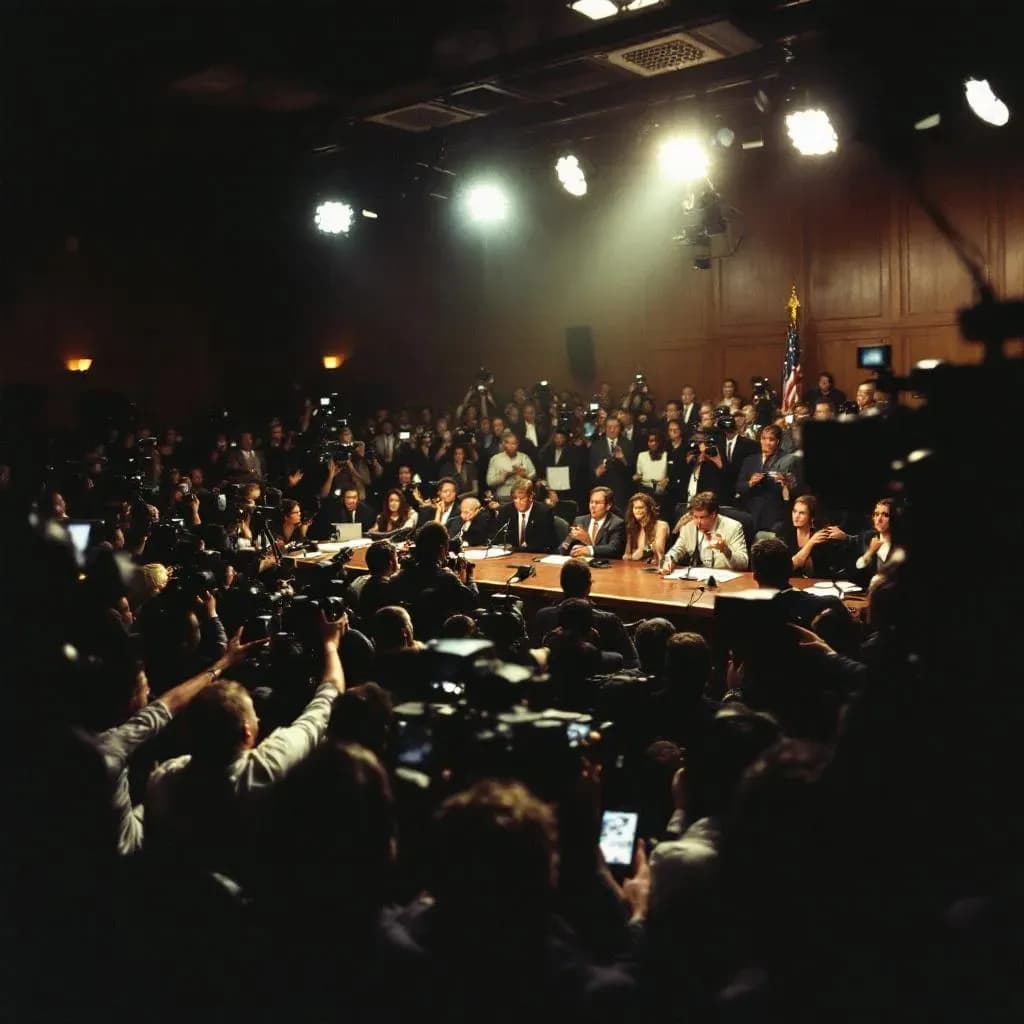
The People v. O.J. Simpson commences with television cameras in the courtroom, making it a national media event.
15 June 1995
The Glove Doesn't Fit
Simpson tries on the bloody gloves in court. They appear not to fit, becoming a turning point in the case.
3 October 1995
Acquittal
After only four hours of deliberation, the jury acquits OJ Simpson. 100 million Americans watch live.
4 February 1997
Civil Verdict
A civil jury finds Simpson liable for the murders and orders him to pay $33.5 million in damages.
The prosecution presented DNAevidence that seemed overwhelming at the time. Blood found at the crime scene matched Simpson's profile at odds of 1 in 170 million. Blood on socks recovered from his home matched at 1 in 6.8 billion. Witnesses like limousine driver Allan Park and houseguest Kato Kaelin provided testimony placing Simpson at key moments. Yet the defense systematically challenged every piece of physical evidence, questioning police handling, pointing to Detective Mark Fuhrman's documented racist past, and arguing that evidence had been planted. When defense witness Henry Lee, a renowned forensic scientist, examined the prosecution's DNA work, he simply stated: "Something's wrong."
Over eight months, 150 witnesses testified. Simpson never took the stand. The jury—composed of 9 African-Americans, 1 Hispanic, and 2 white jurors, predominantly women—deliberated for less than four hours before reaching their verdict on October 3, 1995: not guilty of the murders.
The announcement stunned much of America. For many observers, the verdict seemed to contradict the forensic evidence. For others, it represented a necessary check on a system with a documented history of racism and abuse. The exposed deep fractures in how different Americans understood justice, race, and reasonable doubt.
But the legal saga did not end there. Beginning in October 1996, a civil trial allowed the victims' families to pursue a wrongful death claim. This time, a jury found Simpson liable, ordering him to pay $8.5 million in compensatory damages and $25 million in punitive damages—a total of $33.5 million.
Decades later, Simpson's legal troubles continued. In 2008, he was convicted of robbery and kidnapping related to a Las Vegas incident and received a 9-33 year sentence. He was granted parole in 2013.
The O.J. Simpson trial remains the watershed moment in modern true crime—a case that exposed the fragility of certainty in criminal justice, the power of narrative and race in jury deliberations, and the complex relationship between forensic science and reasonable doubt. It changed not just how Americans understood the legal system, but how true crime itself would be covered, discussed, and consumed for generations to come.