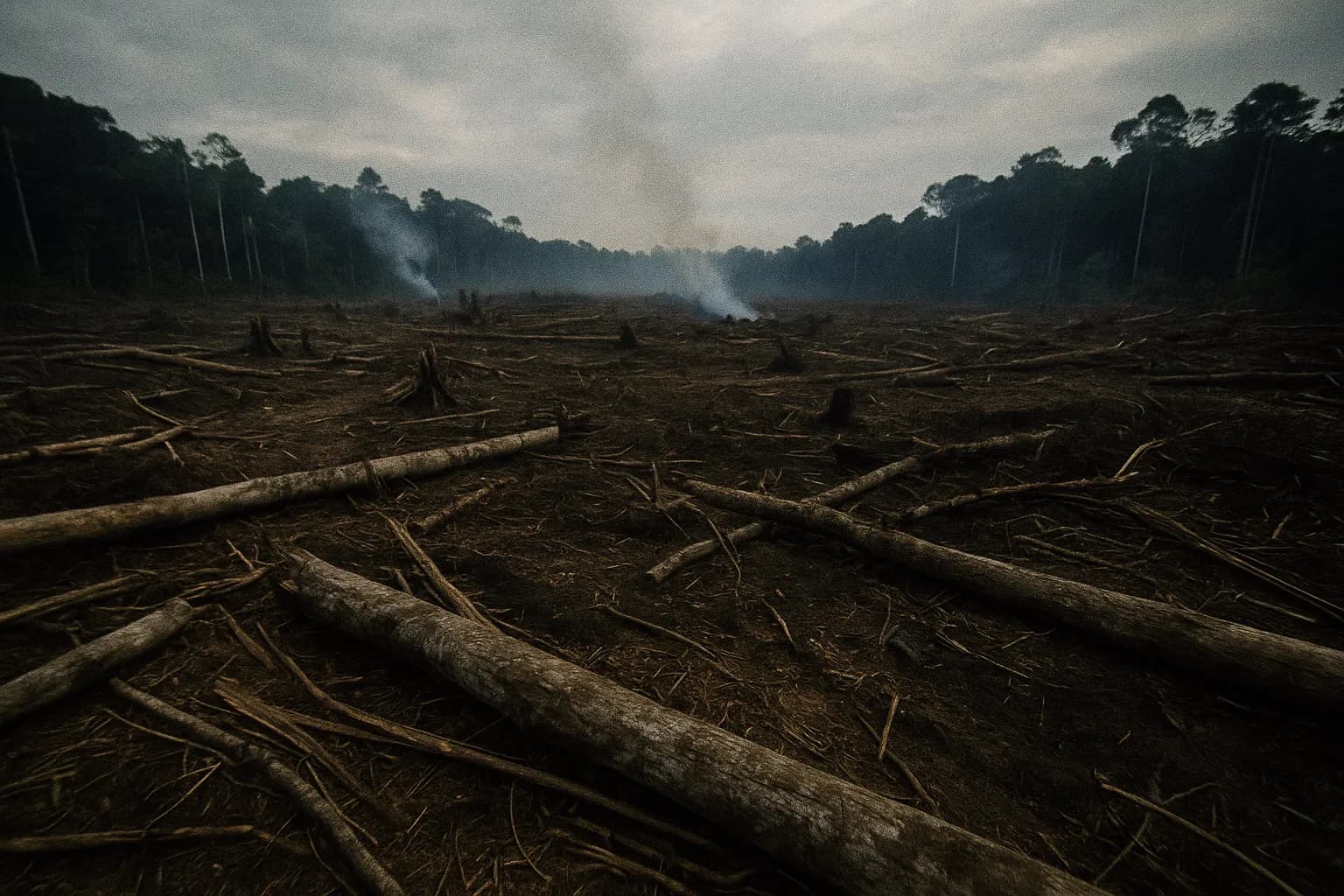
The palm oil industry operates as one of global commerce's most troubling supply chains, with documented evidence of child exploitation and environmental devastation spanning Indonesia, West Papua, and beyond.
Development organizations including Rainforest Rescue and Danish investigative sources have directly accused Nestlé's palm oil suppliers of child labor violations. The problem extends across the industry: worker exploitation and child labor remain endemic to palm oil production, according to WWF-UK assessments. Most damning is evidence that even RSPO-certified plantations—those bearing the Roundtable on Sustainable Palm Oil's voluntary certification mark—have documented child labor violations, raising serious questions about the certification system's effectiveness since its establishment in 2004.
**Deforestation at Industrial Scale**
The environmental toll mirrors the human one. In 2019 alone, Nestlé recorded over 1,000 deforestation cases daily across its supply chain, with satellite monitoring documenting 388,047 cases that year. The company consumed 455,000 tons of palm oil in 2019, and researchers cannot rule out rainforest destruction for nearly one-third of that volume.
Indonesia has lost 24 million hectares of rainforest to palm plantations between 1990 and 2015—a staggering conversion of biodiverse ecosystems into monoculture plantations. The Indonesian province of Aceh in Sumatra exemplifies these dynamics: PT Dua Perkasa Lestari, a Nestlé supplier connected through Golden Agri Resources, operates on deep peat soil and allegedly lacks proper permits. The company stands accused of land grabbing, field destruction, resident threats, and forced expulsions—practices spanning decades with communities who have documented their resistance through NGOs including LBH and Walhi.
The RSPO certification system, intended as an industry safeguard, has failed to prevent environmental crime. Analysis of the 2015 and 2019 forest fire crises found that 75 percent of implicated brands operated within RSPO-certified areas. Though the RSPO implemented a deforestation ban in 2018, enforcement remains negligible across certified plantations worldwide.
**Corporate Pledges and Persistent Violations**
Nestlé pledged in 2010 to eliminate deforestation from its raw materials by 2020. By March 2020, the company verified 70 percent of its palm oil as deforestation-free—falling short of the absolute commitment made a decade earlier. Unilever and Colgate-Palmolive face similarly persistent accusations linking them to suppliers with documented labor and environmental violations.
In West Papua, the Awyu and Moi peoples continue fighting four palm oil companies over 39,190 hectares of land taken without free, prior, and informed consent—a violation of international indigenous rights standards. These disputes underscore how palm oil expansion routinely disregards the territorial and legal rights of communities inhabiting targeted regions.
**The Certification Illusion**
The RSPO operates as a voluntary certification system rather than a legally binding enforcement mechanism. This voluntary structure has enabled widespread violations to persist even within certified supply chains, effectively creating a "green wash" that reassures international consumers while material conditions on the ground remain unchanged.
For true crime readers, the palm oil scandal represents a case study in how corporate supply chains enable systemic exploitation—of children, workers, indigenous communities, and ecosystems—while maintaining plausible deniability through certification schemes that lack teeth. The documented scale of child labor and environmental destruction, coupled with corporate knowledge and documented non-compliance with stated commitments, frames this industry's operations as a persistent, multi-jurisdictional crime affecting millions.
**Sources**
https://www.rainforest-rescue.org/topics/palm-oil/nestle
https://blog.lasaponaria.it/en/insights/palm-oil-why-it-is-more-controversial-than-it-seems
https://www.wwf.org.uk/updates/8-things-know-about-palm-oil
https://www.kriminyt.dk/da/palmeolie-skandalen-miljkriminalitet-og-brnearbejde