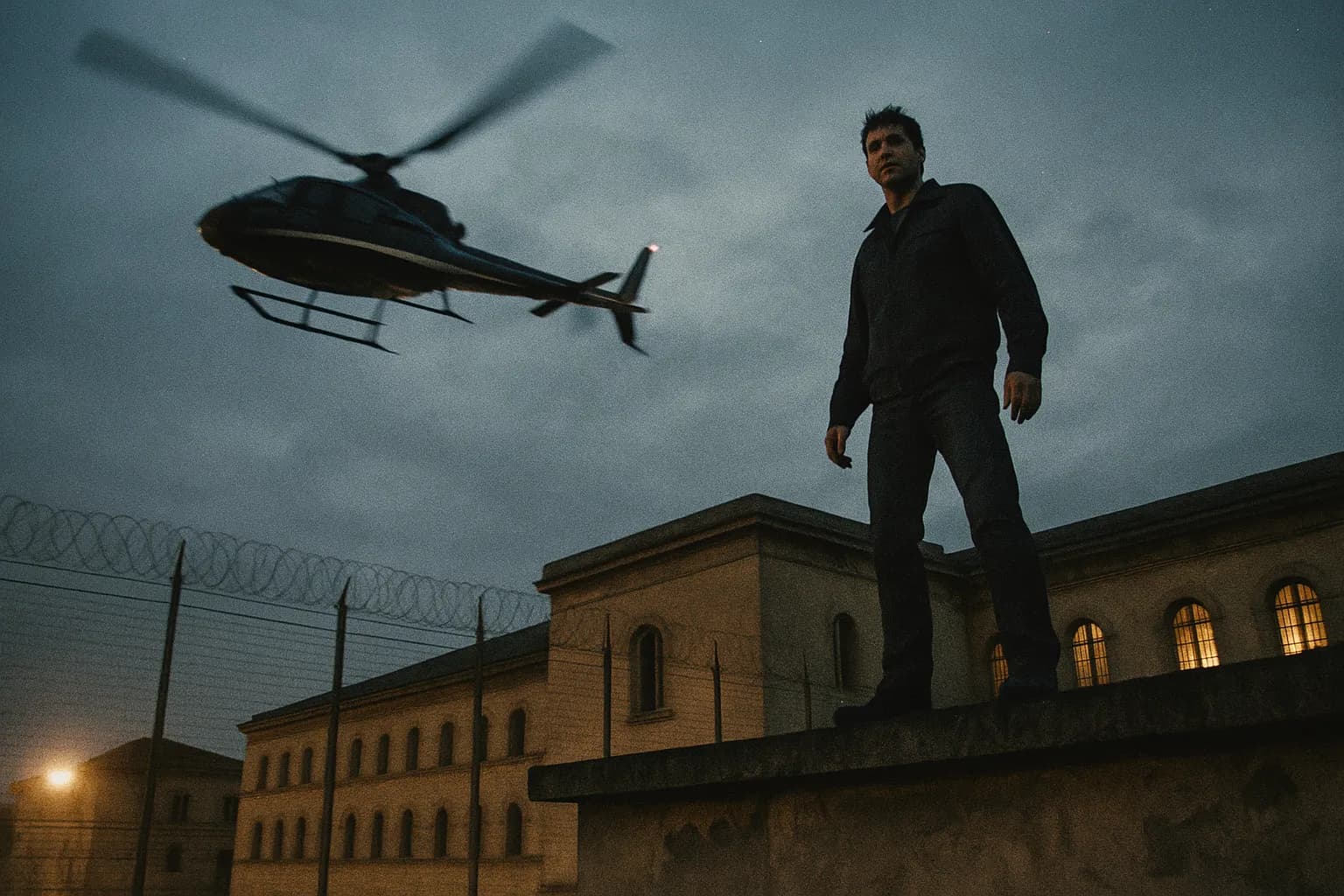
On 12 October 2001, a helicopter descended toward Luynes Prison near Aix-en-Provence in southeastern France with a singular purpose: to extract prisoner Pascal Payet from his cell. Within three minutes, the 38-year-old French convict was airborne and free. The first of his three audacious helicopter escapes had succeeded.
Payet's criminal trajectory began years earlier. Born on 7 July 1963 in Fréjus, France, he became involved in organized crime under the nickname "Kalashnikov Pat." In 1997, he participated in a security van robbery that turned fatal—a murder conviction followed in 1999, landing him a 30-year sentence at Luynes Prison in the Bouches-du-Rhône region.
But a three-decade stretch proved intolerable. In collaboration with accomplice Frédéric Impocco, Payet arranged the first helicopter escape. The operation's brevity—under three minutes—suggested careful planning and inside knowledge of prison routines. While Payet vanished into the French underworld, his accomplice's freedom proved short-lived; Impocco was captured in Paris just six days later on 18 October 2001.
Timeline
7 July 1963
Geburt von Pascal Payet
Pascal Payet wird in Frankreich geboren.
1 January 1997
Mord bei Raubüberfall
Payet begeht einen Mord während eines bewaffneten Raubüberfalls auf einen Werttransport in Frankreich.
1 January 1999
Verurteilung zu 30 Jahren Haft
Pascal Payet wird wegen Mordes bei bewaffnetem Raubüberfall zu 30 Jahren Gefängnis verurteilt.
12 October 2001
Erster Helikopter-Ausbruch
Payet entkommt zusammen mit Frédéric Impocco per Helikopter aus dem Gefängnis Luynes.
14 April 2003
Zweiter Helikopter-Ausbruch
Payet organisiert erneut einen Helikopter-Ausbruch aus dem Gefängnis Luynes und befreit drei weitere Häftlinge. Diese werden drei Wochen später wieder gefasst.
14 July 2007
Dritter Helikopter-Ausbruch
Am französischen Nationalfeiertag flieht Payet zum dritten Mal per Helikopter, diesmal aus dem Gefängnis Grasse. Vier maskierte Männer entführen einen Helikopter vom Flughafen Cannes-Mandelieu.
16 July 2007
Europäischer Haftbefehl
Zwei Tage nach dem dritten Ausbruch wird ein europäischer Haftbefehl gegen Payet ausgestellt.
1 September 2007
Festnahme in Spanien
Pascal Payet wird in Spanien festgenommen und nach Frankreich zurückgebracht. Seine Strafe wird um 9 Jahre auf insgesamt 39 Jahre verlängert.
1 January 2024
Weiterhin inhaftiert
Pascal Payet sitzt noch immer in einem französischen Gefängnis ein. Frankreich hat inzwischen seine Luftsicherheit bei Gefängnissen massiv verstärkt.
Payet's notoriety didn't fade with his disappearance. In fact, he became more audacious. On 14 April 2003, another helicopter landed at Luynes Prison—but this time, Payet orchestrated the escape for others. Three prisoners—Franck Perletto, Michel Valero, and Éric Alboreo—were lifted out in a breakout lasting mere minutes. The operation demonstrated that Payet had maintained connections on the outside and possessed the resources to fund elaborate prison breaks. However, security forces worked swiftly; all three escapees were recaptured within three weeks.
Payet himself remained at large, a ghost in the European criminal underworld. For four years, he evaded capture across borders. But the draw of orchestrating another dramatic escape proved irresistible—or perhaps desperation mounted.
On 14 July 2007, Bastille Day, Payet struck again. This time, his target was Grasse Prison, a different facility in the Provence-Alpes-Côte d'Azur region. Four masked accomplices hijacked a helicopter from nearby Cannes-Mandelieu Airport and flew it directly to the prison. In less than five minutes, Payet was extracted once more. The pilot was released unharmed, suggesting the operation prioritized efficiency over violence.
But this final escape came with a cost. European authorities mobilized within 48 hours, issuing an arrest warrant across the continent. Payet's freedom would not last. By some point after his July 2007 escape, Spanish authorities located and detained him. On 4 October 2007, just three months after his Bastille Day breakout, Payet was returned to France.
The additional escapes carried serious legal consequences. French courts added 6 to 9 years to his sentence—sources vary on the exact length—pushing his total incarceration period well beyond the original 30 years. His initial 30-year term had already been substantial; now he faced decades more.
As of 2024, Pascal Payet remains incarcerated in France under maximum security conditions. His three helicopter escapes stand as one of the most brazen and resourceful prison breaks in modern European criminal history. Whether viewed as a mastermind of aerial logistics or a desperate man willing to risk everything for freedom, Payet's saga exposed security gaps in facilities across France and demonstrated the reach of organized crime networks capable of financing such elaborate operations.
The helicopter king's reign has ended—for now, behind bars.