Rédoine Faïd burst into infamy in the 1990s as the ringleader of a criminal gang responsible for armed robberies, jewel thefts, and extortion across the Paris region. Together with Jean-Claude Bisel, Faïd orchestrated heists targeting armored trucks carrying cash and high-value jewelry. By 1997, law enforcement had caught up with the operation. Seven of eight suspects were brought to trial; the eighth fled to Algeria.
Faïd himself eluded capture for three years, using Switzerland and Israel as hideouts while authorities hunted him across Europe. In his later autobiography, Faïd would claim he disguised himself as an Orthodox Jew during this period, learned Hebrew, and received firearms training from an Israeli soldier. Whether fact or embellishment, the story underscores his resourcefulness. He was finally arrested in 1998 and handed a 30-year prison sentence. After serving a decade, he was released on parole.
His freedom proved temporary. In 2010, Faïd became entangled in a failed robbery that resulted in the death of French police officer Aurélie Fouquet. He would ultimately serve 25 years for his role in that operation—a sentence that would define the next phase of his criminal notoriety.
Timeline
10 May 1972
Geburt von Rédoine Faïd
Rédoine Faïd wird in Frankreich geboren
29 May 1998
Erste Festnahme
Nach drei Jahren auf der Flucht wird Faïd festgenommen und zu 30 Jahren Haft verurteilt
13 April 2013
Erste spektakuläre Flucht
Faïd sprengt sich mit Sprengstoff aus dem Sequedin-Gefängnis frei und nimmt vier Wärter als Geiseln
29 May 2013
Wiederergreifung
Faïd wird in Pontault-Combault festgenommen, knapp zwei Monate nach seiner Flucht
1 July 2018
Helikopter-Flucht
Mit Hilfe von drei Komplizen und einem Helikopter gelingt Faïd die Flucht aus dem Réau-Gefängnis
On 13 April 2013, while incarcerated at Sequedin prison, Faïd orchestrated a brazen escape that shocked the French authorities. Using explosives, he blasted through five prison doors, then took four prison wardens hostage as leverage. An accomplice—Sabri Trad, a former special forces officer—waited outside in a getaway car. The pair drove to Lille, where they torched the vehicle and switched to another. Within weeks, Interpol issued a Europe-wide warrant. Faïd was recaptured on 29 May 2013 in a bed-and-breakfast in Pontault-Combault, Seine-et-Marne, after intelligence suggested he was attempting to obtain forged documents for passage to Israel.
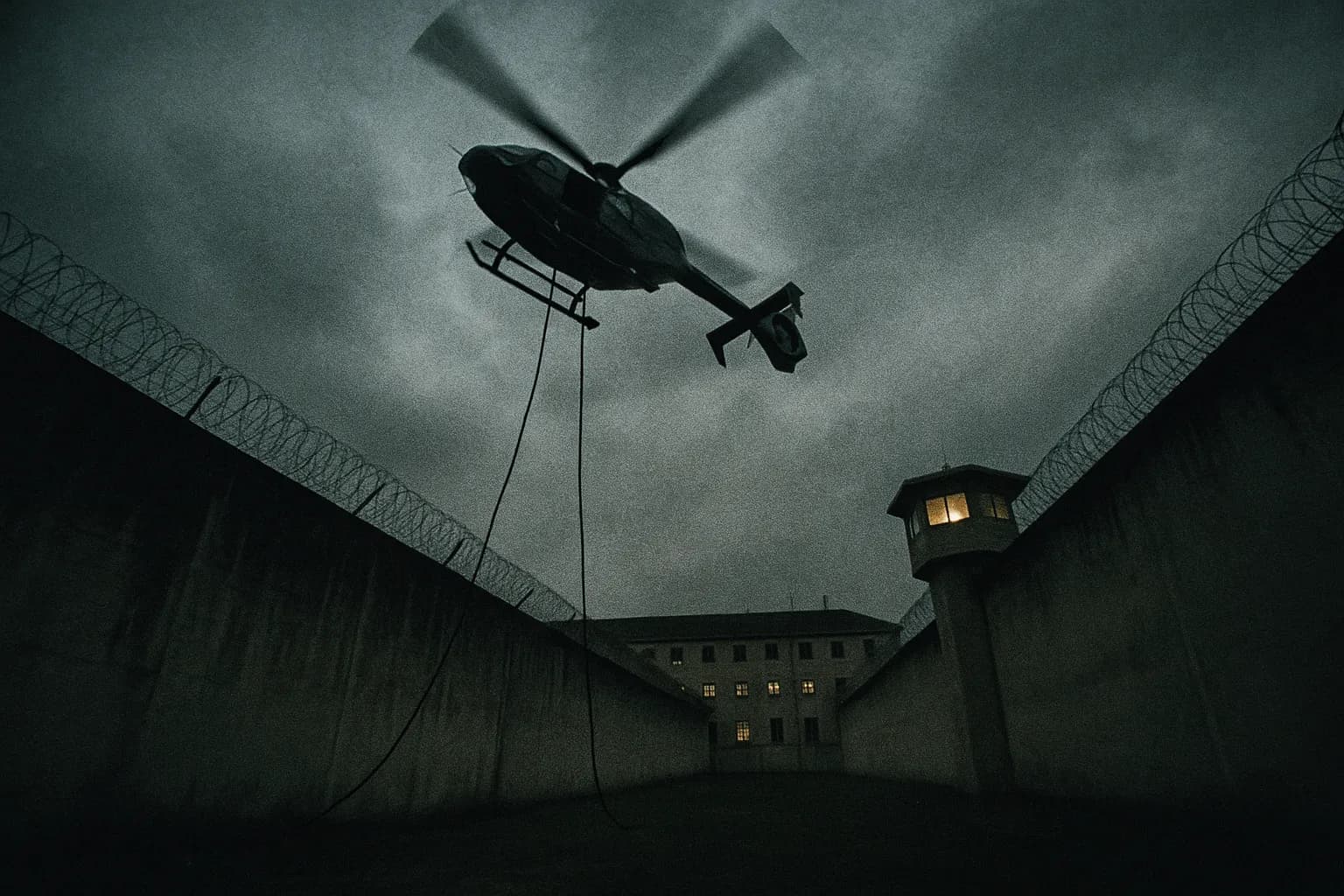
The recapture barely slowed him. On 1 July 2018, at approximately 11:30 am, Faïd engineered an even more audacious escape from Réau prison. Three armed accomplices arrived in a hijacked Aérospatiale Alouette II helicopter and hovered above the facility. Prison staff heard the rotor blades before they could respond. Using an angle grinder, Faïd's team cut through prison doors while guards scrambled to mount a defense. The helicopter touched down, Faïd climbed aboard, and the aircraft lifted away. The entire operation unfolded in minutes.
This escape cemented Faïd's reputation as France's foremost escape artist and a criminal of extraordinary cunning. His exploits—explosives, hostages, hijacked helicopters—read like a heist film rather than court records. Yet the reality behind the spectacle remained deadly serious. A police officer had been killed. Guards had been terrorized. And Faïd remained at large, a symbol of state vulnerability.
Faïd's criminal philosophy, laid bare in his autobiography, betrays both calculation and arrogance. He documented his crimes, his escapes, and his survival tactics with the candor of someone convinced his story deserved telling. Whether that autobiography was written before or after his final capture, it remains a window into the mind of a man who saw prison as merely a temporary obstacle.
By 2013, French media had dubbed him "public enemy number one"—a title earned through violence, cunning, and an almost theatrical disregard for the justice system. His story raises uncomfortable questions about prison security, the limits of law enforcement, and the psychology of criminals who view incarceration not as punishment but as a challenge to be overcome.