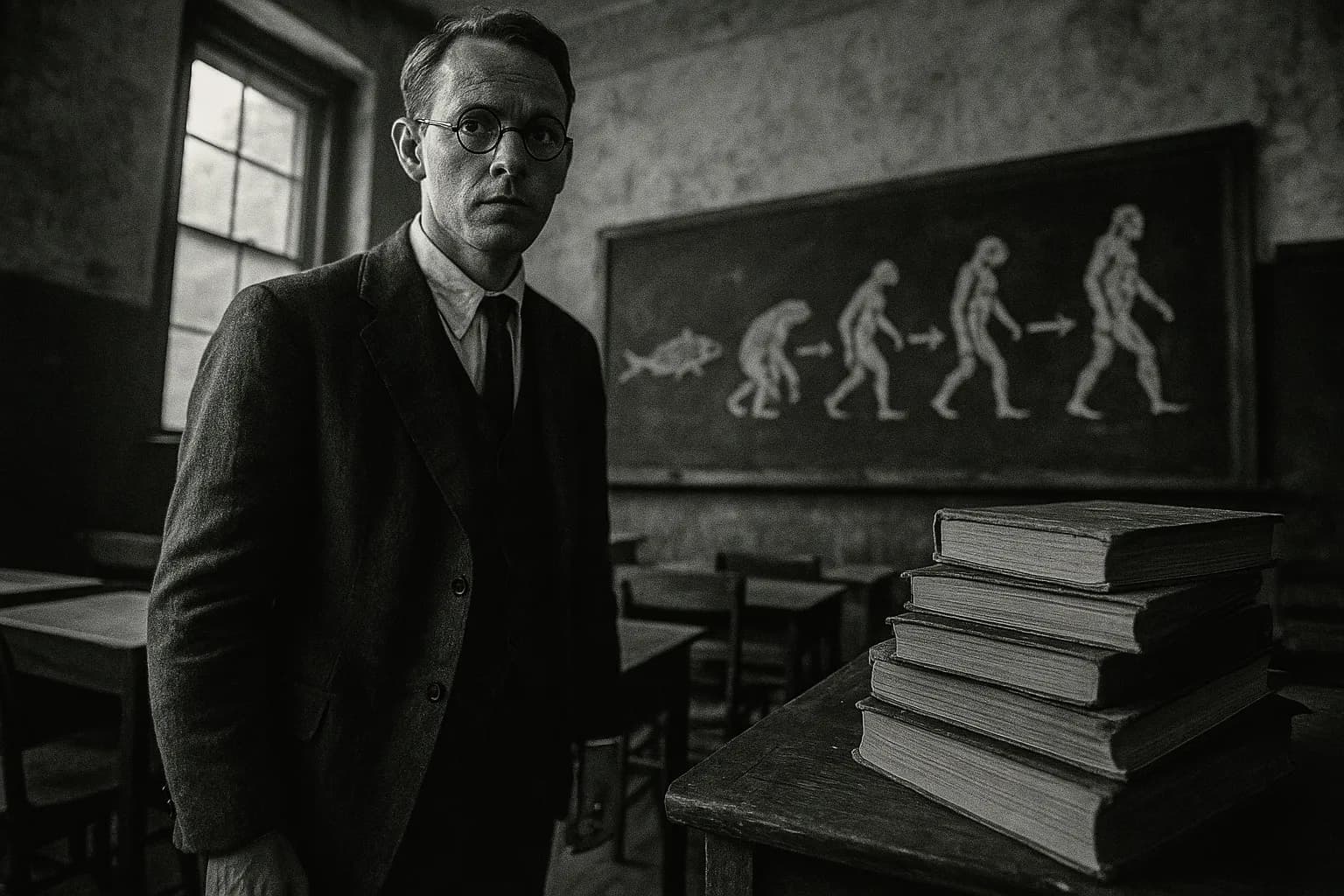
On May 7, 1925, high school teacher John Thomas Scopes was arrested in Dayton, Tennessee, for violating a state law that had been on the books for less than three months. His crime: teaching human evolution to his biology class. What followed was one of the most publicized trials in American legal history—a clash between science and religious doctrine that would dominate headlines and divide the nation.
The Butler Act, passed by the Tennessee legislature in March 1925, made it illegal for teachers in public schools to present "any theory that denies the story of the Divine Creation of man as taught in the Bible, and to teach instead that man has descended from a lower order of animals." The law represented a victory for fundamentalist Christian groups concerned that Darwinian evolution was undermining biblical authority.
But the trial itself was something of a setup. Dayton's business leaders, seeking publicity for their struggling town, encouraged Scopes to participate in a test case. The American Civil Liberties Union, eager to challenge the Butler Act's constitutionality, had publicly offered to defend anyone prosecuted under it. Scopes, a 24-year-old math and physics teacher who had substituted in biology class, agreed to be the defendant—despite uncertainty about whether he had actually taught evolution directly.
Timeline
13 March 1925
Butler Act wird verabschiedet
Tennessee verbietet per Gesetz den Unterricht der Evolutionstheorie an öffentlichen Schulen.
9 May 1925
Verhaftung von John Scopes
Der 24-jährige Lehrer wird in Dayton wegen Verstoßes gegen den Butler Act verhaftet.
10 July 1925
Prozessbeginn
Der Scopes-Prozess beginnt am Rhea County Criminal Court und wird erstmals live im Radio übertragen.
21 July 1925
Schuldspruch
Die Jury spricht Scopes schuldig und verhängt eine Geldstrafe von 100 Dollar.
1 January 1967
Ende des Butler Act
Nach 42 Jahren wird das Gesetz gegen Evolutionsunterricht in Tennessee offiziell aufgehoben.
The courtroom became theater. When the trial began on July 10, 1925, it attracted an unprecedented level of media attention. This was the first trial to be broadcast live on radio, reaching audiences across the country. Dayton was overrun with journalists, curious onlookers, and religious activists. The atmosphere outside the courthouse was carnival-like, with vendors selling refreshments and religious signs covering the town.
The legal teams were heavyweight. The prosecution was led by William Jennings Bryan, the former U.S. Secretary of State and three-time presidential candidate, who had become the face of American fundamentalism. Defending Scopes was Clarence Darrow, one of the nation's most renowned criminal defense attorneys, joined by Arthur Garfield Hays of the ACLU. Their battle was less about Scopes' actions than about the proper relationship between religion, science, and state authority.
Judge John T. Raulston controlled the trial's scope tightly. He ruled that expert testimony about evolution's scientific validity was irrelevant and that constitutional questions about free speech and religious liberty were off-limits. The trial would focus solely on one question: Did Scopes teach evolution? The answer was yes—he admitted it, and three students testified before the grand jury that he had taught an evolution chapter from the textbook.
With the factual question settled, the trial's drama faded. On July 21, 1925, the jury deliberated for just nine minutes before returning a guilty verdict. Scopes was convicted of a misdemeanor and fined $100—the maximum penalty under the Butler Act.