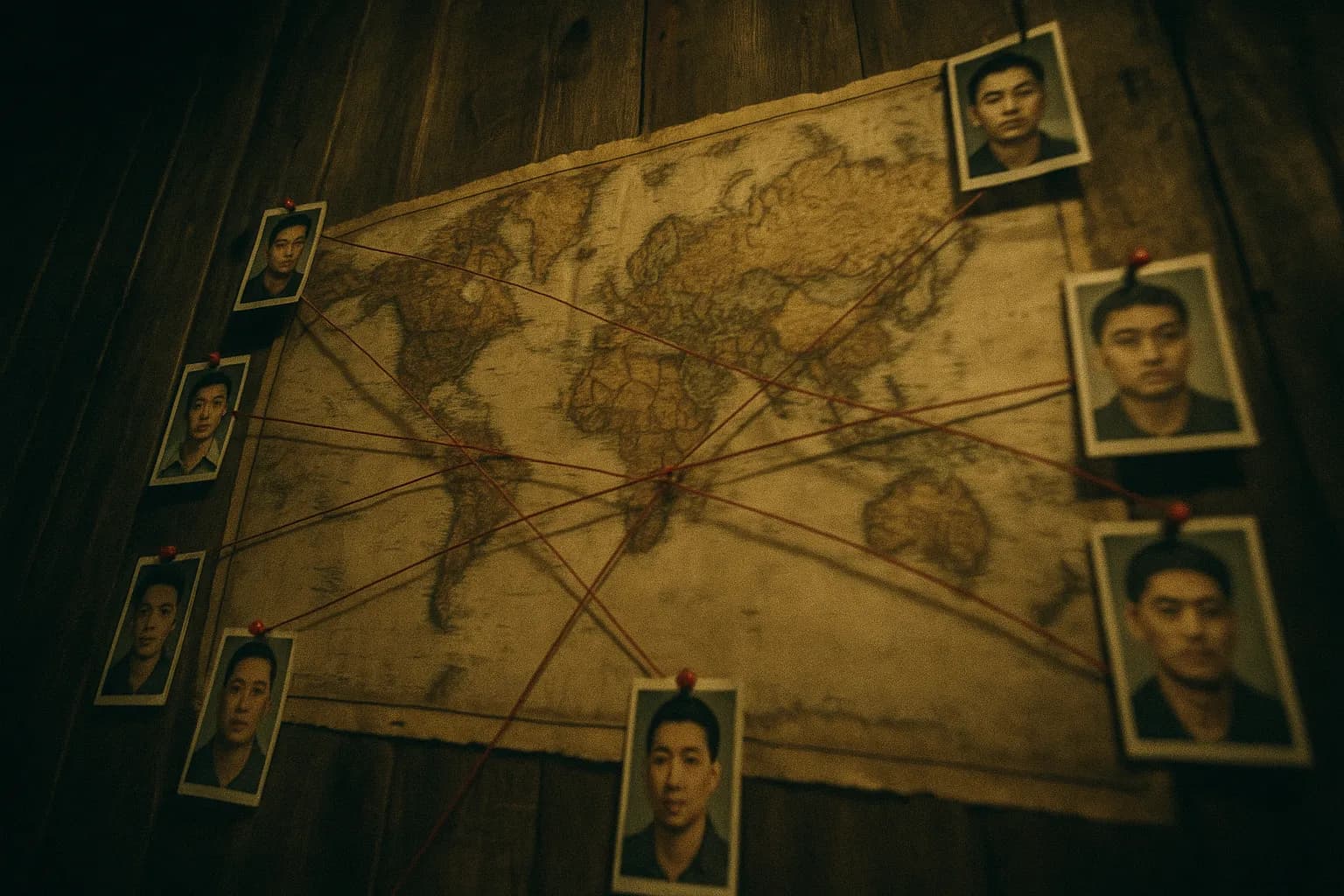
The United Bamboo Gang (竹聯幫), known colloquially as Bamboo Union or UBG, emerged in the mid-1950s as a collection of predominantly mainland Chinese migrants who had fled to Taiwan after the communist revolution. What started as a local street gang evolved into one of Asia's most sophisticated criminal organizations, with tentacles reaching across the Pacific and into the digital underworld.
## From Muscle to Money
Throughout the 1980s, the gang's operations centered on traditional organized crime: extortion, debt collection, gambling rings, protection rackets, and prostitution. But by the 1990s, the United Bamboo recognized that the real money lay elsewhere. The organization diversified dramatically, establishing legitimate fronts in security, construction, and entertainment while simultaneously building a sophisticated drug trafficking network. By the 2020s, the gang had become a major player in underground banking, bid-rigging, and—perhaps most troublingly—large-scale cybercrime and human trafficking operations launched from mainland China.
Timeline
1 January 1957
Gründung der United Bamboo Gang
Kinder festlandchinesischer Flüchtlinge gründen in Taiwan eine Straßengang, die sich zur größten Triade des Landes entwickeln wird.
15 October 1984
Mord an Henry Liu
Der chinesisch-amerikanische Journalist Henry Liu wird in Daly City bei San Francisco von Auftragskillern der Triade ermordet. Der Fall erregt internationale Aufmerksamkeit.
1 November 2024
Großrazzia gegen die Organisation
Taiwanesische Behörden verhaften 134 mutmaßliche Mitglieder der United Bamboo Gang wegen verschiedener Verbrechen, darunter Menschenhandel und Mord.
The gang's structure, organized into 13 divisions with 68 branches, proved flexible enough to accommodate this expansion. Partnerships with Japanese yakuza and multi-ethnic triads, notably the Sam Gor syndicate, gave United Bamboo access to international supply chains and money laundering networks. Chinatowns in California and Las Vegas became operational hubs for the organization's American ventures.
## Notorious Figures and Bloody Violence
Chang An-lo, known as "White Wolf," epitomized the gang's international ambitions. An early leader of United Bamboo, he relocated to Las Vegas in 1968 and later served a decade in U.S. federal prison for drug smuggling. Rather than fade into obscurity, White Wolf resurfaced decades later as the leader of the Chinese Unification Promotion Party (CUPP), operating from Shenzhen as a fugitive while maintaining influence over gang operations.
Bai Xiao Ye, a Bamboo Union hitman, illustrated the gang's capacity for brutal violence. In July 2009, he stabbed and slashed a man to death inside a Las Vegas karaoke bar, wounding two others in the process. Authorities later linked him to a fatal shooting at a Los Angeles karaoke bar as well. In 2013, he received a sentence of life imprisonment without parole.
## Government Entanglement
Perhaps the most damaging revelation about United Bamboo concerns its historical relationship with Taiwan's government. Prior to the mid-1980s, the gang was knowingly employed by Taiwanese intelligence agencies, including the National Security Bureau and Intelligence Bureau. Gang members served as close aides to high-ranking government officials and were admitted to military, police, and intelligence academies by the ruling KMT party. Some rose to top government positions, blurring the line between organized crime and state apparatus.
This corruption reached its peak in the 1980s, exemplified by the 1986 New York trial of eight United Bamboo members charged under RICO statutes with gambling, drug trafficking, prostitution—and the of journalist Henry Liu. The exposed how deeply the gang had infiltrated law enforcement itself; an agent named Steven Wong had been recruited into the organization.
By 2024, Taiwan's government moved aggressively against United Bamboo and its political wing. Taiwan President Lai Ching-te publicly condemned ties between CUPP and the Chinese Communist Party. The Interior Ministry pursued the dissolution of CUPP on national security grounds. In November 2024, Taiwan police suspected 134 CUPP members of crimes including obstruction of justice, human trafficking, and homicide. Over a five-year period, authorities seized nearly 200 firearms from CUPP members and affiliates.
The United Bamboo Gang's evolution from a mid-20th-century street gang to a sophisticated international criminal enterprise reveals how organized crime adapts and expands. With estimated 20,000 members, partnerships spanning continents, and operations in both the physical and digital realms, the gang remains one of Asia's most formidable criminal organizations—and a cautionary tale about the dangers of government complicity in organized crime.