True crime news logo
  • Podcasts Movies & Series Books
  • News
True crime news logo

Components made easy. This cool starter template will help you get started with your next project.

© 2026 Company Name. All rights reserved.

Powered by Nerdic

    Sagsmappe

    Maze Escape 1983: IRA's bold feat, 38 prisoners

    Mappe Åbnet: JUNE 6, 2025 AT 10:00 AM
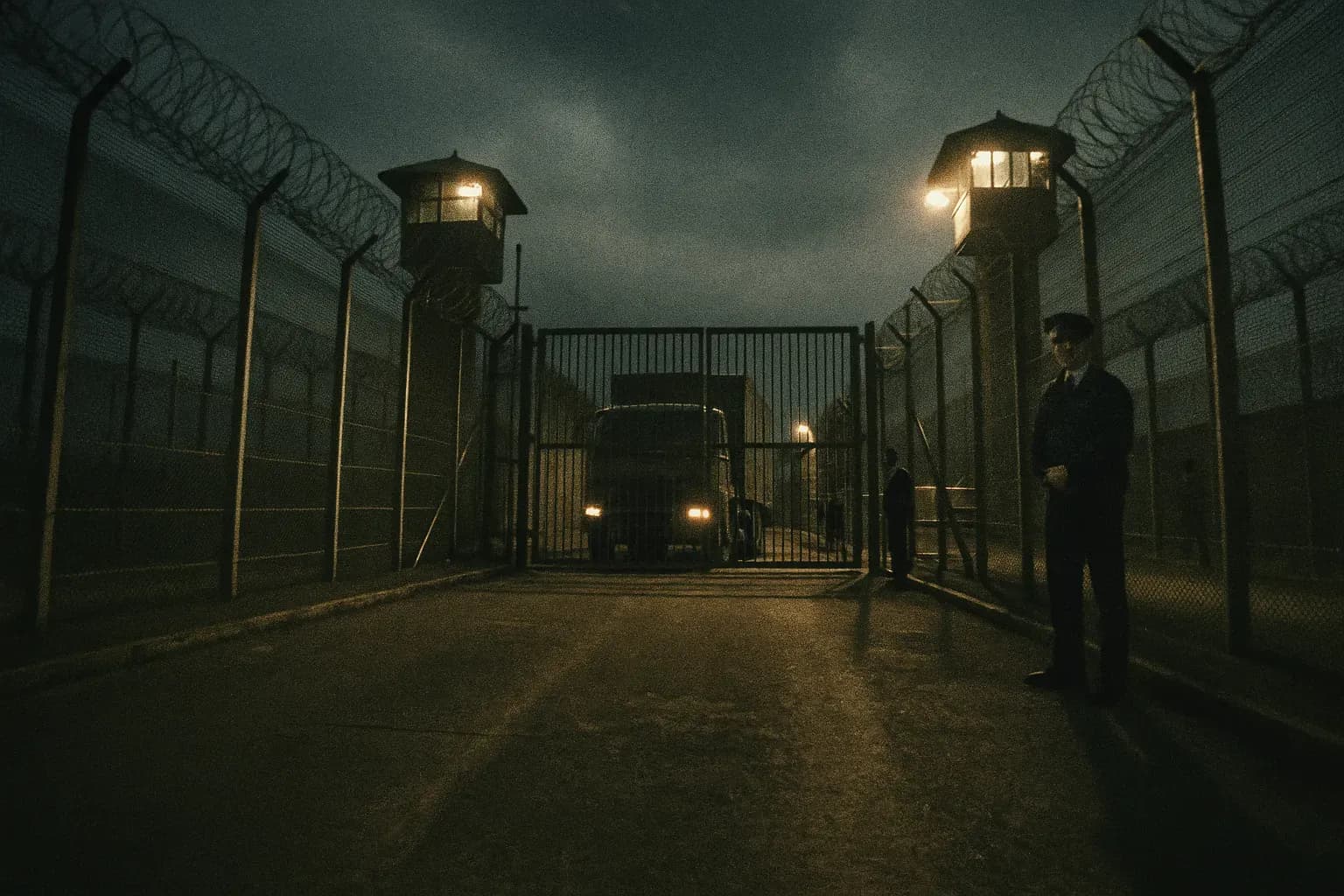
    A guarded lorry gate at Maze Prison, surrounded by high security fences and watchtowers, symbolizes the historic 1983 breakout involving 38 IRA prisoners.
    BEVIS

    Sagsdetaljer

    Quick Facts

    Klassifikation:

    Escape
    Terror
    Hostages
    Warfare
    United Kingdom
    Fangeskab
    Military

    September 25, 1983: IRA escape from Maze, UK's largest

    September 25, 1983, became a landmark date, forever etched in British prison history. On this day, 38 prisoners from the Provisional IRA (PIRA) executed a spectacular [Internal Link Placeholder] from HM Prison Maze in Northern [Internal Link Placeholder] – an institution considered among Europe's most secure, located just 15 km southwest of Belfast. This historic mass escape, the largest in Britain's peacetime history, was not a spontaneous breakout. It was the culmination of months of meticulous planning, extensive arms smuggling, and a daring exploitation of the prison's internal routines. The notorious Maze Prison escape exposed serious security flaws and became a symbolic victory for republicans amidst the turbulent period known as The Troubles, a conflict marked by [Internal Link Placeholder] and political unrest.

    Maze Prison: From fortress to escape via H7's lorry

    The Maze Prison, also known as Long Kesh, was designed as a maximum-security fortress, specifically built to house [Internal Link Placeholder] inmates. With its characteristic H-blocks, surrounded by 5.5-meter-high concrete walls, electronically controlled steel doors, and constant [Internal Link Placeholder] from armed watchtowers, it had a reputation as an almost inescapable prison. The prisoners, living under strict confinement, were segregated by affiliation. In 1983, H-Block 7 (H7) housed around 130 IRA members, most convicted of serious crimes, including acts designated by the authorities as [Internal Link Placeholder]. The prison's structure, where each block functioned as a semi-autonomous unit with its own facilities, created predictable routines. This very predictability became a key element in the [Internal Link Placeholder] plan. As one of those involved later explained: "Security was based on routines, and the daily arrival of the [Internal Link Placeholder] lorry at 2:15 PM to H7 was identified as the perfect opportunity."

    IRA's committee: McFarlane and Kelly planned smuggling

    Planning for the daring [Internal Link Placeholder] began in early 1983 under the direction of a secret IRA escape committee. Key figures such as Brendan "Bik" McFarlane and Gerry Kelly spearheaded the detailed reconnaissance. Under the guise of cleaning duties, they mapped alarms, guard routes, and the prison layout from inside H7. Simultaneously, an extensive operation to smuggle

    Shooting
    Violence
    Scandal
    Historical
    War crimes
    Sted
    HM Prison Maze, County Antrim, Northern Ireland
    [Internal Link Placeholder]
    was underway. Over several months, they managed to get six 9mm pistols past the guards, carefully concealed in various items brought by visitors – from packed lunches and books to musical instruments. The escape plan itself was drawn up with almost
    [Internal Link Placeholder]
    precision. It involved taking over the control room, taking guards hostage, changing into guard uniforms,
    [Internal Link Placeholder]
    the
    [Internal Link Placeholder]
    lorry, and a precisely calculated time window: from the takeover of H7, the lorry had to be out of the main gate in under 20 minutes to prevent the alarm from being raised.

    Escape from H7: Ferris' death, alarm at Tally Lodge 1

    At 2:25 PM on the day of the [Internal Link Placeholder], the prisoners put their plan into action. Three prisoners, armed with the smuggled [Internal Link Placeholder] in the form of pistols hidden in newspapers, overpowered the guards in H7's control room. During the ensuing violent struggle, Officer James Ferris was seriously wounded by a stab to the stomach; he subsequently suffered a heart attack and died. Within twenty minutes, the entire H7 block was under prisoner control, and 38 men, aged 19 to 42, were ready to make their move towards freedom. At 2:50 PM, the scheduled Bedford [Internal Link Placeholder] lorry arrived. The driver, Derek McDonnell, was taken hostage and forced into the back of the lorry, while the prisoners took over the vehicle. With 15 prisoners hidden in the cargo bay and 23 disguised in stolen guard uniforms, the lorry drove towards the prison's main gates. However, at the first security barrier, Tally Lodge 1, things went wrong. An alert guard saw through the disguises and triggered the silent alarm at 3:07 PM. Wild chaos erupted as prisoners opened fire on the guards. Officer William McConnell was shot in the thigh. In the total confusion, the prisoners in the lorry managed to break through the final gate and scatter into the surrounding fields near Lisburn in Northern [Internal Link Placeholder]. At 3:15 PM, the entire prison was put on lockdown, and [Internal Link Placeholder] began circling the area in pursuit of the escapees.

    Aftermath: Criticism of Hennessy Report, IRA's victory

    The [Internal Link Placeholder] manhunt following the daring [Internal Link Placeholder] was intensive. Using [Internal Link Placeholder] and roadblocks, authorities managed to recapture 15 of the 38 escapees before sunset on the same day. The remaining 23 reached safe houses, primarily in republican areas of Northern [Internal Link Placeholder]. However, several were later recaptured, including key planners like Brendan McFarlane and Gerry Kelly, who were found in the [Internal Link Placeholder] and subsequently extradited to the UK. Several other escapees from HM Prison Maze later lost their lives in further IRA operations, often linked to [Internal Link Placeholder] and politically motivated acts. The British government immediately launched an inquiry led by Sir James Hennessy. His report, the Sir James Hennessy Report, published in January 1984, was highly critical, pointing to a "[Internal Link Placeholder] of carelessness" among prison staff and inadequate searching of visitors, which had enabled the arms smuggling. The report resulted in the implementation of 73 recommendations, including strengthening control room security and introducing biometric access control. Despite many recaptures, the Maze Prison escape became a significant propaganda victory for the IRA, demonstrating that even the most secure prison was not impenetrable. This historic escape still stands as a remarkable example of a complexly orchestrated operation that combined [Internal Link Placeholder] planning with a deep understanding of security system vulnerabilities. Its consequences influenced future security procedures in high-security prisons globally, and the story of the [Internal Link Placeholder] and the incredible escape from Long Kesh is still discussed today.

    Sources:

    • rte.ie
    • time.com
    • parliament.uk
    • parliament.uk
    • irishcentral.com

    Follow KrimiNyt for more in-depth analyses of historical prison escapes and the IRA's most notorious operations.
    Quick Facts

    TranscriptNot Available
    Verified PurchaseNo
    SubtitlesNot Available
    Show more details
    VerifiedUnverified
    LocationHM Prison Maze, County Antrim, Northern Ireland
    Related Content
    Generation Kill exposes the brutality of war

    Generation Kill exposes the brutality of war

    A narrow, partially hidden tunnel entrance at Stalag Luft III, surrounded by makeshift tools and dirt, symbolizing the escape route used by 76 Allied prisoners during World War II.

    The Great Escape: Stalag Luft III to Hitler's List

    A dark, cramped underground tunnel with dirt walls, a small group of Union officer uniforms wriggling through, led by a figure resembling Colonel Rose, symbolizing their daring escape from Libby Prison.

    Colonel Rose's 1864 tunnel escape førom Libby Prison

    A figure resembling Antonio Ferrara stands in handcuffs outside a Belgian police station, flanked by officers.

    Antonio Ferrara: Master of Escapes and 2025 Capture

    Advertisement

    Susanne Sperling

    Admin

    Share this post:
    Sagsmappe

    Maze Escape 1983: IRA's bold feat, 38 prisoners

    Mappe Åbnet: JUNE 6, 2025 AT 10:00 AM
    A guarded lorry gate at Maze Prison, surrounded by high security fences and watchtowers, symbolizes the historic 1983 breakout involving 38 IRA prisoners.
    BEVIS

    Sagsdetaljer

    Quick Facts

    Klassifikation:

    Escape
    Terror
    Hostages
    Warfare
    United Kingdom
    Fangeskab
    Military
    Shooting
    Violence
    Scandal
    Historical
    War crimes
    Sted
    HM Prison Maze, County Antrim, Northern Ireland

    September 25, 1983: IRA escape from Maze, UK's largest

    September 25, 1983, became a landmark date, forever etched in British prison history. On this day, 38 prisoners from the Provisional IRA (PIRA) executed a spectacular [Internal Link Placeholder] from HM Prison Maze in Northern [Internal Link Placeholder] – an institution considered among Europe's most secure, located just 15 km southwest of Belfast. This historic mass escape, the largest in Britain's peacetime history, was not a spontaneous breakout. It was the culmination of months of meticulous planning, extensive arms smuggling, and a daring exploitation of the prison's internal routines. The notorious Maze Prison escape exposed serious security flaws and became a symbolic victory for republicans amidst the turbulent period known as The Troubles, a conflict marked by [Internal Link Placeholder] and political unrest.

    Maze Prison: From fortress to escape via H7's lorry

    The Maze Prison, also known as Long Kesh, was designed as a maximum-security fortress, specifically built to house [Internal Link Placeholder] inmates. With its characteristic H-blocks, surrounded by 5.5-meter-high concrete walls, electronically controlled steel doors, and constant [Internal Link Placeholder] from armed watchtowers, it had a reputation as an almost inescapable prison. The prisoners, living under strict confinement, were segregated by affiliation. In 1983, H-Block 7 (H7) housed around 130 IRA members, most convicted of serious crimes, including acts designated by the authorities as [Internal Link Placeholder]. The prison's structure, where each block functioned as a semi-autonomous unit with its own facilities, created predictable routines. This very predictability became a key element in the [Internal Link Placeholder] plan. As one of those involved later explained: "Security was based on routines, and the daily arrival of the [Internal Link Placeholder] lorry at 2:15 PM to H7 was identified as the perfect opportunity."

    IRA's committee: McFarlane and Kelly planned smuggling

    Planning for the daring [Internal Link Placeholder] began in early 1983 under the direction of a secret IRA escape committee. Key figures such as Brendan "Bik" McFarlane and Gerry Kelly spearheaded the detailed reconnaissance. Under the guise of cleaning duties, they mapped alarms, guard routes, and the prison layout from inside H7. Simultaneously, an extensive operation to smuggle [Internal Link Placeholder] was underway. Over several months, they managed to get six 9mm pistols past the guards, carefully concealed in various items brought by visitors – from packed lunches and books to musical instruments. The escape plan itself was drawn up with almost [Internal Link Placeholder] precision. It involved taking over the control room, taking guards hostage, changing into guard uniforms, [Internal Link Placeholder] the [Internal Link Placeholder] lorry, and a precisely calculated time window: from the takeover of H7, the lorry had to be out of the main gate in under 20 minutes to prevent the alarm from being raised.

    Escape from H7: Ferris' death, alarm at Tally Lodge 1

    At 2:25 PM on the day of the [Internal Link Placeholder], the prisoners put their plan into action. Three prisoners, armed with the smuggled [Internal Link Placeholder] in the form of pistols hidden in newspapers, overpowered the guards in H7's control room. During the ensuing violent struggle, Officer James Ferris was seriously wounded by a stab to the stomach; he subsequently suffered a heart attack and died. Within twenty minutes, the entire H7 block was under prisoner control, and 38 men, aged 19 to 42, were ready to make their move towards freedom. At 2:50 PM, the scheduled Bedford [Internal Link Placeholder] lorry arrived. The driver, Derek McDonnell, was taken hostage and forced into the back of the lorry, while the prisoners took over the vehicle. With 15 prisoners hidden in the cargo bay and 23 disguised in stolen guard uniforms, the lorry drove towards the prison's main gates. However, at the first security barrier, Tally Lodge 1, things went wrong. An alert guard saw through the disguises and triggered the silent alarm at 3:07 PM. Wild chaos erupted as prisoners opened fire on the guards. Officer William McConnell was shot in the thigh. In the total confusion, the prisoners in the lorry managed to break through the final gate and scatter into the surrounding fields near Lisburn in Northern [Internal Link Placeholder]. At 3:15 PM, the entire prison was put on lockdown, and [Internal Link Placeholder] began circling the area in pursuit of the escapees.

    Aftermath: Criticism of Hennessy Report, IRA's victory

    The [Internal Link Placeholder] manhunt following the daring [Internal Link Placeholder] was intensive. Using [Internal Link Placeholder] and roadblocks, authorities managed to recapture 15 of the 38 escapees before sunset on the same day. The remaining 23 reached safe houses, primarily in republican areas of Northern [Internal Link Placeholder]. However, several were later recaptured, including key planners like Brendan McFarlane and Gerry Kelly, who were found in the [Internal Link Placeholder] and subsequently extradited to the UK. Several other escapees from HM Prison Maze later lost their lives in further IRA operations, often linked to [Internal Link Placeholder] and politically motivated acts. The British government immediately launched an inquiry led by Sir James Hennessy. His report, the Sir James Hennessy Report, published in January 1984, was highly critical, pointing to a "[Internal Link Placeholder] of carelessness" among prison staff and inadequate searching of visitors, which had enabled the arms smuggling. The report resulted in the implementation of 73 recommendations, including strengthening control room security and introducing biometric access control. Despite many recaptures, the Maze Prison escape became a significant propaganda victory for the IRA, demonstrating that even the most secure prison was not impenetrable. This historic escape still stands as a remarkable example of a complexly orchestrated operation that combined [Internal Link Placeholder] planning with a deep understanding of security system vulnerabilities. Its consequences influenced future security procedures in high-security prisons globally, and the story of the [Internal Link Placeholder] and the incredible escape from Long Kesh is still discussed today.

    Sources:

    • rte.ie
    • time.com
    • parliament.uk
    • parliament.uk
    • irishcentral.com

    Follow KrimiNyt for more in-depth analyses of historical prison escapes and the IRA's most notorious operations.

    Quick Facts

    TranscriptNot Available
    Verified PurchaseNo
    SubtitlesNot Available
    Show more details
    VerifiedUnverified
    LocationHM Prison Maze, County Antrim, Northern Ireland
    Related Content
    Generation Kill exposes the brutality of war

    Generation Kill exposes the brutality of war

    A narrow, partially hidden tunnel entrance at Stalag Luft III, surrounded by makeshift tools and dirt, symbolizing the escape route used by 76 Allied prisoners during World War II.

    The Great Escape: Stalag Luft III to Hitler's List

    A dark, cramped underground tunnel with dirt walls, a small group of Union officer uniforms wriggling through, led by a figure resembling Colonel Rose, symbolizing their daring escape from Libby Prison.

    Colonel Rose's 1864 tunnel escape førom Libby Prison

    A figure resembling Antonio Ferrara stands in handcuffs outside a Belgian police station, flanked by officers.

    Antonio Ferrara: Master of Escapes and 2025 Capture

    Advertisement

    Susanne Sperling

    Admin

    Share this post: