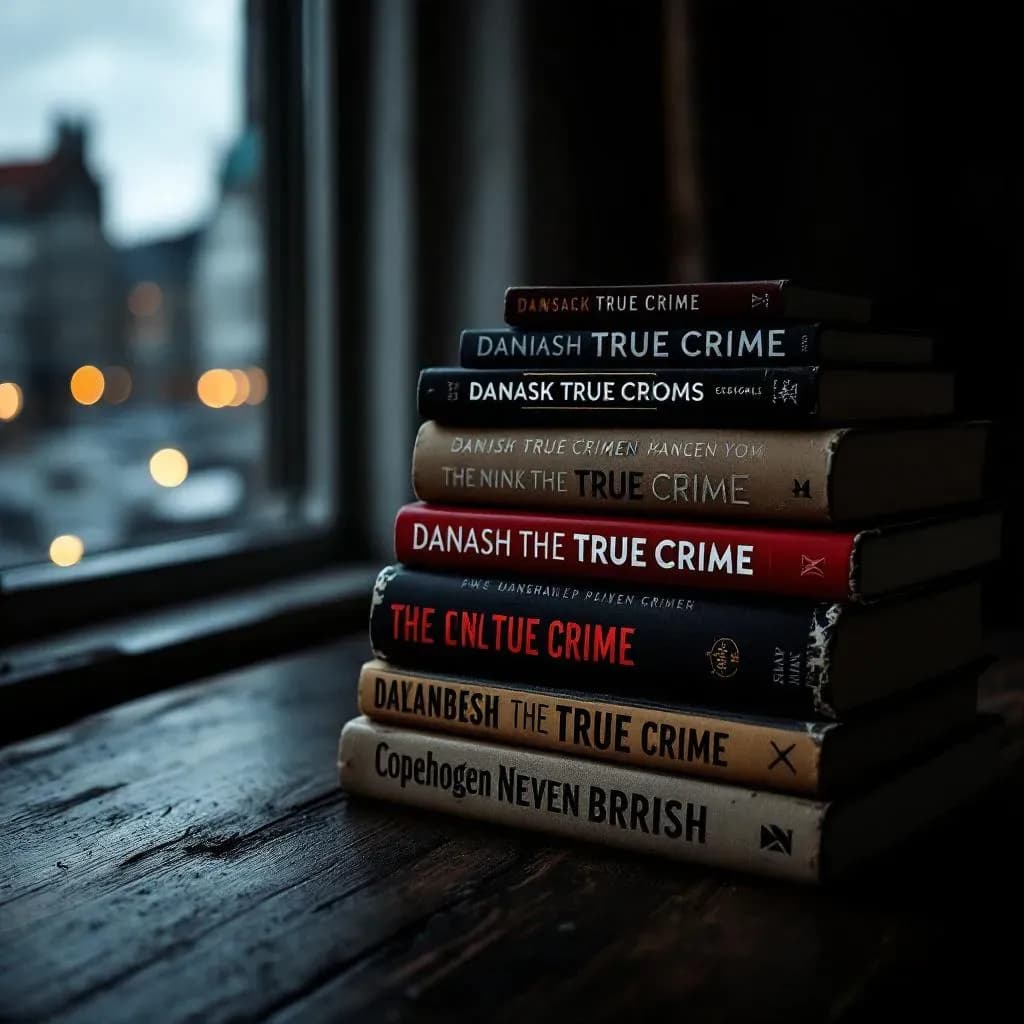
The 10 Best Danish True Crime Books
Danish true crime authors have established themselves as masters of investigative storytelling, transforming complex criminal cases into compelling narratives that captivate readers worldwide. These meticulously researched books matter because they not only document Denmark's most shocking crimes but also illuminate the cultural and social factors that shape Scandinavian criminal justice. For true crime enthusiasts, Nordic noir fans, and readers seeking authentic investigative journalism, Danish true crime literature offers an unparalleled blend of rigorous fact-finding and narrative tension.
The Essential Danish True Crime Collection
1. Den Tavse Pige (The Quiet Girl) by Kristian Corfixen
This haunting investigation examines the 1990 disappearance of Christina Karlsen from Copenhagen, a case that remained unsolved for over two decades. Corfixen, an award-winning journalist, spent five years interviewing witnesses, reviewing police files, and uncovering new evidence that eventually led to a breakthrough. The book meticulously reconstructs the timeline of events leading to Christina's disappearance and explores the failures of the initial police investigation. Corfixen's narrative reveals how changing forensic technology finally brought closure to the case in 2013, resulting in a conviction that shocked Denmark.
2. Bandenkrigens Hemmeligheder (Secrets of the Gang War) by Morten Skjoldager
Skjoldager provides an unprecedented inside look at Copenhagen's violent gang conflicts between 2008 and 2017, which resulted in over 50 deaths and transformed quiet neighborhoods into war zones. Drawing from exclusive interviews with former gang members, police investigators, and families of victims, the book exposes the complex network of loyalties, betrayals, and violent retribution that defined this dark period. The author details specific incidents, including the 2013 shooting at Nørrebro station and the firebombing of Blågårds Plads. Skjoldager's investigative work helped authorities understand the organizational structure of Danish criminal networks.
3. Amagermordet (The Amager Murder) by Henrik Krüger
Krüger's detailed account of the 1968 murder of four-year-old Helle Crafts shocked Denmark and led to one of the country's most controversial wrongful conviction cases. The book examines how police pressure, unreliable witness testimony, and outdated forensic methods resulted in the imprisonment of an innocent man for over 16 years. Through interviews with the wrongfully convicted Palle Sørensen and newly discovered evidence, Krüger demonstrates the catastrophic consequences of tunnel vision in criminal investigations. The case ultimately led to significant reforms in Danish police interrogation procedures and the establishment of a criminal cases review commission in 2012.
4. Blekingegadebanden (The Blekinge Street Gang) by Peter Øvig Knudsen
This masterwork chronicles Denmark's most audacious criminal-political conspiracy, where left-wing activists robbed banks throughout the 1970s and 1980s to fund Palestinian liberation movements. Knudsen spent a decade researching the gang's operations, interviewing members, and accessing classified police documents to reveal how the group stole over 10 million kroner. The book details the gang's sophisticated planning, their connections to international terrorism, and the massive police operation that finally brought them down in 1989. Knudsen's work won numerous awards and was adapted into a critically acclaimed television series, cementing its place as essential Danish crime literature.
5. Drabet på Pernille (The Murder of Pernille) by Mads Brügger
Brügger investigates the brutal 1989 murder of 16-year-old Pernille Sørensen in Elsinore, a case marked by investigative incompetence and lost evidence that allowed the killer to remain free for 28 years. The book exposes how crucial DNA evidence was mishandled and witnesses were dismissed, creating a textbook example of police failure. Through meticulous reconstruction of that fatal night, Brügger reveals new information that eventually contributed to solving the case in 2017. His work demonstrates how persistent journalism can succeed where initial investigations fail, offering hope to families of other unsolved cases across Denmark.
6. Dobbeltmordet i Hvidovre (The Hvidovre Double Murder) by Lars Kragh Andersen
Andersen examines the shocking 2004 double murder of a mother and daughter in suburban Copenhagen, a case that exposed Denmark's inadequate response to domestic violence warnings. The book details how Maria Hansen and her daughter Anna were killed by Maria's ex-husband despite multiple restraining orders and police reports. Through extensive interviews with family members, law enforcement, and social workers, Andersen reveals systemic failures that allowed a known violent offender to access his victims. The case prompted nationwide reforms in how Danish authorities handle domestic violence threats and stalking complaints.
7. Politimordene (The Police Murders) by Thomas Ritter
Ritter provides a comprehensive account of Denmark's most shocking attacks on law enforcement, including the 1965 murder of officer Jørgen Jessen and the 2003 killing of officer Thomas Falk during a routine traffic stop in Copenhagen. The book explores how these rare events traumatized the Danish police force and fundamentally changed policing culture in a nation where officers traditionally patrolled unarmed. Through interviews with colleagues, families, and investigators, Ritter captures the profound impact these murders had on Danish society's perception of safety. His work examines the subsequent debates about police armament and protection protocols.
8. Gidslet (Held Hostage) by Steffen Frøshaug
Frøshaug's gripping narrative recounts Denmark's longest hostage crisis, the 2010 standoff at Århus courthouse where convicted criminal Brian Nielsen held seven people captive for 37 hours while demanding weapons and escape vehicles. The book provides minute-by-minute coverage of negotiations, police tactical decisions, and the psychological warfare between Nielsen and authorities. Drawing from police recordings, hostage testimonies, and psychiatric evaluations, Frøshaug reveals how negotiators prevented a massacre despite Nielsen's violent threats. The case became a training scenario for crisis negotiation teams across Scandinavia and highlighted the importance of patience in hostage situations.
9. Drømmen om Paradis (The Dream of Paradise) by Emma Holten
Holten investigates the disturbing phenomenon of Danish citizens joining ISIS between 2013 and 2017, examining the cases of over 150 individuals who abandoned comfortable lives for extremist violence in Syria and Iraq. The book features interviews with returned fighters, families of those killed abroad, and intelligence officers tracking radicalization networks. Holten explores how online recruitment, social marginalization, and ideological manipulation transformed ordinary Danes into foreign fighters. Her work provides crucial insights into the radicalization process and the challenges of reintegrating returned extremists into Danish society, making it essential reading for understanding modern terrorism.
10. Mordet der Rystede Danmark (The Murder That Shook Denmark) by Kristian Lindhardt
Lindhardt's investigation into the 2017 murder of Swedish journalist Kim Wall aboard Peter Madsen's submarine captivated international attention and exposed the dark psychology of a narcissistic killer. The book meticulously reconstructs Wall's final hours, Madsen's elaborate cover-up attempts, and the exhaustive forensic investigation that secured his conviction despite the absence of complete remains. Through courtroom testimony, police interviews, and expert analysis, Lindhardt reveals how investigators pieced together evidence from the ocean floor and Madsen's digital footprint. The case highlighted both the sophistication of modern forensic science and the persistent danger of trusting charismatic individuals without proper vetting.
The Impact of Danish True Crime Literature
Danish true crime books have transcended entertainment to become important tools for social commentary and criminal justice reform. These works consistently expose systemic failures, challenge wrongful convictions, and keep cold cases in public consciousness, sometimes directly contributing to their eventual resolution. The genre's commitment to investigative rigor over sensationalism has established Danish true crime as a global standard for responsible crime writing.