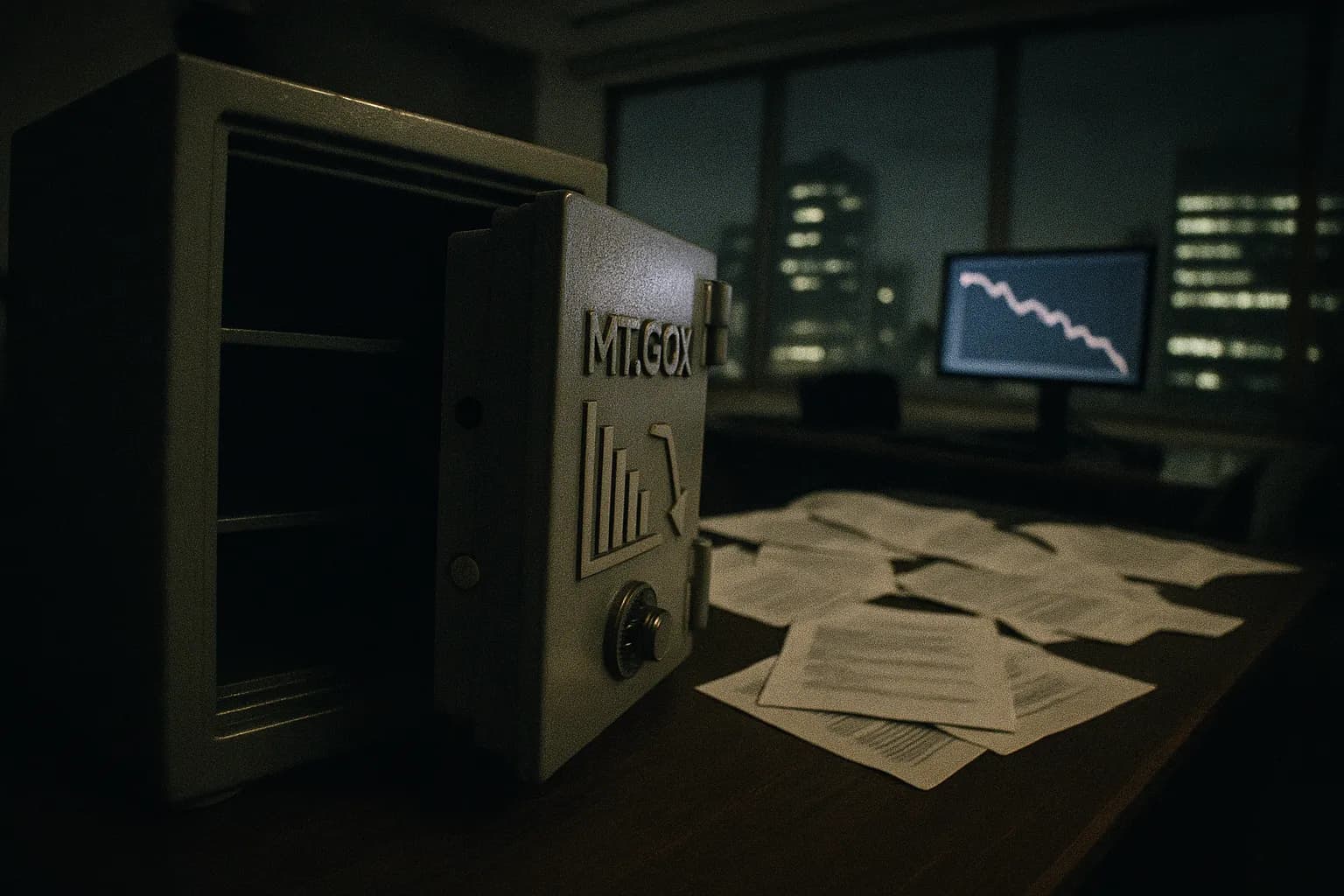
On 24 February 2014, Mt. Gox went dark. The Tokyo-based exchange that handled the majority of global Bitcoin transactions suddenly suspended all trading and took its website offline. Within days, it became clear that the unthinkable had happened: approximately 744,408 Bitcoins had vanished—undetected for years—along with customer funds worth roughly $450 million at the time.
Mark Karpelès, a 29-year-old French businessman, had acquired Mt. Gox from its founder Jed McCaleb in 2011. McCaleb would go on to establish Ripple and Stellar, but his departure from Mt. Gox marked the beginning of the exchange's troubled final chapter. According to Karpelès, 80,000 Bitcoins disappeared between the contract signing and the moment he gained server access—a theft McCaleb allegedly urged him not to disclose to users.
The scale of the actual theft that followed dwarfed even that initial loss. Analysis by WizSec in 2015 revealed that the majority of the stolen Bitcoins had been systematically taken from the exchange's hot wallet beginning in late 2011, yet nobody noticed for years. Initially, Karpelès and others claimed that between 750,000 and 850,000 Bitcoins had been lost, though later accounting narrowed this to approximately 744,408 BTC.
Timeline
7 February 2014
Stopp aller Bitcoin-Auszahlungen
Mt. Gox stoppt alle Bitcoin-Abhebungen ohne nähere Begründung. Nutzer werden zunehmend beunruhigt.
24 February 2014
Komplette Schließung von Mt. Gox
Die Börse wird vollständig geschlossen. 850.000 Bitcoins sind verschwunden, Insolvenzantrag wird vorbereitet.
1 August 2015
Verhaftung von Mark Karpelès
Der französische CEO wird in Japan verhaftet und wegen Dokumentenfälschung und Veruntreuung angeklagt.
25 July 2017
Festnahme von Alexander Vinnik
Der russische BTC-e-Betreiber wird in Griechenland verhaftet. Ihm wird Geldwäsche der Mt. Gox-Gelder vorgeworfen.
15 March 2019
Urteil gegen Karpelès
Japanisches Gericht verurteilt Karpelès wegen Dokumentenfälschung, spricht ihn aber von Betrugsvorwürfen frei.
18 November 2023
Anklage gegen die Hacker
US-Justizministerium klagt Alexey Bilyuchenko und Aleksandr Verner als Drahtzieher des Hackerangriffs an.
The collapse didn't occur in isolation. In 2013, U.S. Department of Homeland Security had seized $5 million from Mt. Gox accounts after Karpelès misrepresented information on banking documents. Months later, in April 2014, the U.S. Financial Crimes Enforcement Network (FinCEN) subpoenaed Karpelès, who did not attend the hearing through his lawyers. Additionally, Mt. Gox servers had unknowingly hosted silkroadmarket.org, the marketplace associated with the Silk Road dark web platform, leading U.S. investigators to briefly suspect Karpelès of being the legendary Dread Pirate Roberts—a theory later disproven.
The immediate aftermath saw Mt. Gox file for bankruptcy in Japan in February 2014, transitioning to liquidation in April. However, approximately 200,000 Bitcoins were eventually recovered in cold storage and remained available for creditor claims.
On 1 August 2015, Japanese authorities arrested Karpelès. He faced charges of embezzlement, aggravated breach of trust, fraud, and manipulating computer systems to inflate account balances. These charges specifically related to his alleged misappropriation of ¥315 million (approximately $2.6 million) in Bitcoin during the six months preceding the collapse—separate from the main theft investigation.
Karpelès's trial began in 2017. On 14 March 2019, Tokyo District Court delivered its verdict: guilty of data manipulation and falsification of records that inflated Mt. Gox's holdings by $33.5 million. He received a sentence of 30 months imprisonment, suspended for four years, meaning he would serve no time unless he reoffended. Significantly, he was acquitted of embezzlement charges.
As for the missing Bitcoins, investigation later tied the theft to Alexander Vinnik, who operated the BTC-e exchange. Vinnik pleaded guilty in the United States but was subsequently swapped to Russia, with sealed from public view. Approximately 650,000 of the stolen Bitcoins remain at large to this day.