Sagsmappe
Nord Stream Sabotage 2022
Sprængninger på gaspipelines i Østersøen
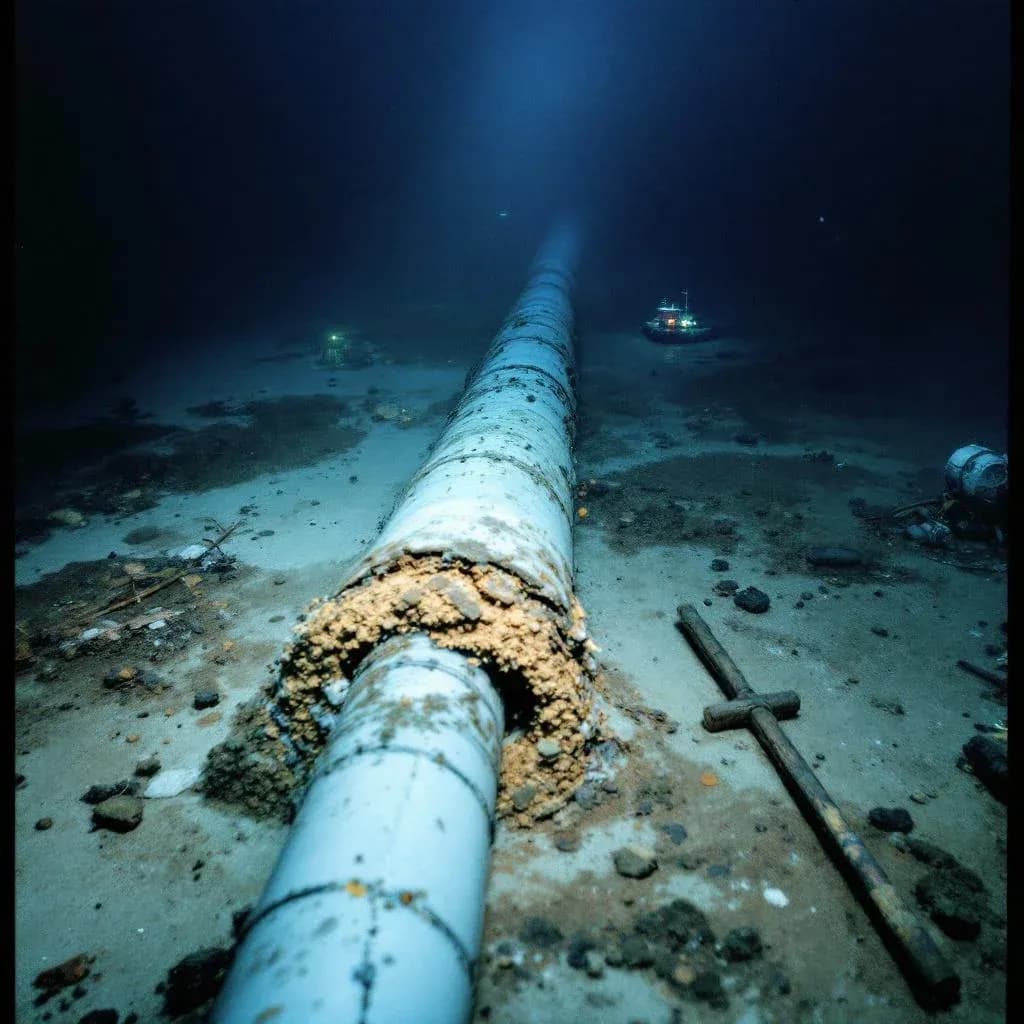
BEVIS
Quick Facts
Gerningsmand(e)Ukendt
Offer(e)Nord Stream 1 og 2 rørledninger
GerningsstedØstersøen ved Bornholm, Danmark
Gerningsdato2022-09-26
ForbrydelsestypeSabotage
Sprængninger på gaspipelines i Østersøen
About the Nord Stream Pipelines
Nord Stream 1 and 2 were critical energy infrastructure linking Russia and Europe.
Nord Stream 1, opened in 2011, transported natural gas from Russian fields through the Baltic Sea to Germany. Nord Stream 2, completed in 2021, was an expansion of the project — though never commercially operational due to political sanctions following Russia's invasion of Ukraine.
Nord Stream 1 geht in Betrieb
Die erste Nord Stream-Pipeline zwischen Russland und Deutschland durch die Ostsee wird in Betrieb genommen.
Nord Stream 2 fertiggestellt
Die zweite Pipeline wird fertiggestellt, aber die Genehmigung wird von Deutschland aufgrund der Ukraine-Invasion gestoppt.
Russische Invasion der Ukraine
Russland marschiert in die Ukraine ein. Westliche Sanktionen werden intensiviert. Nord Stream wird zur geopolitischen Waffe.
Sabotage-Sprengungen
Vier Explosionen werden an Nord Stream 1 und 2 in der Ostsee registriert. Drei Rohrsegmente werden zerstört. Internationale Ermittlungen beginnen.
Offizielle Sabotage-Erklärung
Deutschland, Dänemark und Schweden erklären das Gebiet zum Sabotagebereich. NATO und EU-Kommission äußern Verdacht auf vorsätzlichen Staatsakt.
Ermittlungen dauern an
Nach neun Monaten ist kein Täter identifiziert. Deutschland und Dänemark geben bekannt, dass der Fall ohne konkrete Anklage weiterhin offen bleibt.
The two parallel pipelines lay on the seabed approximately 80 to 100 kilometres from the Danish coast, at a depth of roughly 70 to 90 metres. Each pipeline measured around 1,220 kilometres in length and transported billions of cubic metres of natural gas annually.
The Sabotage Attack on 26 September 2022
On 26 September 2022, at least four powerful explosions were recorded on the Nord Stream pipelines. The Swedish seismic institute USGS registered seismic activity strong enough to be measured on the Richter scale. The explosions struck both Nord Stream 1 and Nord Stream 2 at multiple locations.
The spacing of the detonations throughout the day suggests planned coordination. The three largest explosions affected pipe segments between Sweden and Denmark as well as areas around the Danish and German economic zones.
Denmark, Germany, Sweden and international organisations responded immediately. The area was declared a conflict zone in relation to energy infrastructure. The European Commission and NATO announced that there was strong suspicion of "sabotage of a very serious nature."
Investigation and Theories
Danish, Swedish, German and Norwegian authorities opened parallel investigations. Danish investigators focused on the maritime territory surrounding the blasts.
Numerous theories circulated internationally:
United States and NATO connections: Some American and European sources speculated about the involvement of American operations, given geopolitical interests in severing Europe's dependence on Russian gas. US President Biden had previously threatened to "put an end to Nord Stream 2."
Russia: Ukrainian and Western investigations focused on Russian military capabilities and motives — whether to destabilise Europe or to destroy the pipelines themselves before losing control of them. Russia denied any involvement.
A Ukrainian connection: Some sources pointed to Ukraine's interest in blocking Russian energy influence over Europe.
Unidentified actors: Investigators maintained an open mind regarding the scale of the operation — possibly involving multiple countries or non-state actors.
Denmark's PET and Germany's BND worked alongside Swedish and Norwegian security services. No group or nation was officially charged in a court of law, and the case remained under without any publicly confirmed resolution.
Geopolitical Context
The sabotage occurred nine months after Russia's invasion of Ukraine in February 2022. By September, energy had become a weapon — Russia had reduced gas supplies to Europe in response to Western sanctions, triggering an energy crisis across the continent.
Nord Stream had become central to the debate over European energy independence. Germany was heavily dependent on Russian gas — Nord Stream had supplied around 35 percent of German gas imports before the crisis.
The explosions eliminated any possibility of future gas flows through Nord Stream, locking Europe onto a path away from Russian energy — in some respects irreversibly.
Aftermath
The EU accelerated its plans for energy independence from Russia. Germany, Europe's largest economy, shifted massively to alternatives: biogas, LNG (liquefied natural gas) from the United States and other sources, and renewable energy.
Denmark's role as a host country for parts of the infrastructure made it a key party in the investigation. Committees of inquiry were established.
Infrastructure security became the subject of sweeping reinforcement across Europe. Critical energy infrastructure was classified as a high-priority defence target.
As of this date, Nord Stream 1 and 2 have not been repaired. The damaged pipe segments remain on the seabed.
Status
The case is regarded as an unsolved act of sabotage and terrorism, subject to ongoing international investigation. No nation or group has admitted responsibility or been legally convicted in connection with the sabotage. The investigation remains one of the most significant energy security inquiries in postwar European history.