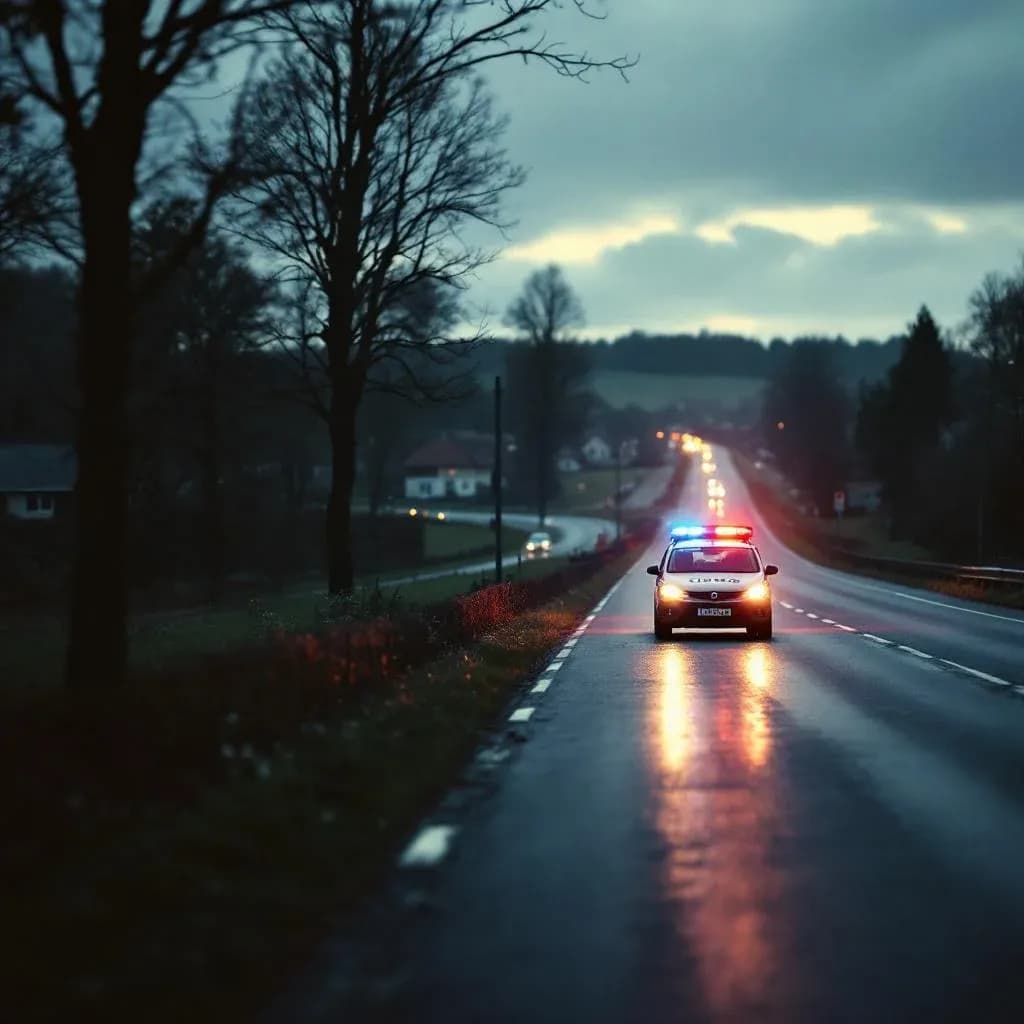
In the early hours of 31 January 2022, a routine patrol from the Kusel area was dispatched to check a white VW Passat on Hauptstraße, the main road between Kusel and Ulmet in the German state of Rhineland-Palatinate. It was the beginning of one of the most talked-about police cases in Germany in many years.
The two officers — Yasmin Wybitul, 24, and Alexander Heindorf, 29 — were both capable and experienced members of the force. Wybitul was among the younger officers in the unit, while Heindorf had more years on the job behind him. Neither had any reason to expect anything out of the ordinary when they approached the vehicle at around 4:30 a.m.
Timeline
31 January 2022
Tödliche Schüsse bei Verkehrskontrolle
Gegen 04:30 Uhr werden die Polizisten Yasmin Wybitul und Alexander Heindorf bei einer Verkehrskontrolle auf der K22 bei Kusel erschossen.
31 January 2022
Großfahndung läuft an
Hunderte Polizisten aus mehreren Bundesländern beginnen mit der Fahndung nach den Tätern.
1 February 2022
Festnahme der Verdächtigen
Andreas S. und Marvin H. werden festgenommen. Die Beweislage gegen sie ist erdrückend.
29 November 2022
Prozessbeginn in Kaiserslautern
Vor dem Landgericht Kaiserslautern beginnt der Prozess gegen die beiden Angeklagten.
16 January 2023
Urteil gesprochen
Andreas S. wird zu lebenslanger Haft verurteilt, Marvin H. erhält 13 Jahre Gefängnis.
As they closed in on the car, everything went catastrophically wrong. Without warning, shots were fired at the officers. Both Wybitul and Heindorf were hit and died of their wounds shortly afterwards. The killings sent shockwaves not only through their families, but through the entire German police service and the wider public.
The deaths of two uniformed officers triggered an enormous law enforcement mobilisation. Hundreds of officers from multiple German states were deployed to hunt down the perpetrators. Germany's interior minister described the attack as an assault on the state itself.
The investigation focused on identifying the car and its occupants. Video footage and witness accounts were pursued on a broad front. German policing circles drew parallels to other attacks on uniformed officers in recent memory.
Before long, two men were apprehended: Andreas S. and Marvin H., both 38 years old. They were arrested on the strength of compelling evidence, including ballistic analysis, video material and eyewitness testimony. Both men had prior criminal records.
The trial was held at the Landgericht — the regional court — in Kaiserslautern and attracted considerable media attention throughout. Prosecutors presented a substantial body of evidence linking both defendants to the killings.
Andreas S. was sentenced to life imprisonment — a term that under German law means "ohne Bewährung," with no possibility of parole for a minimum of fifteen years. It was the most severe punishment available under German law for homicide.
Marvin H. was sentenced to thirteen years in prison. The sentence reflected the court's assessment of his less central role compared to Andreas S., even though both were found guilty in connection with the same crime.
Impact and aftermath
The murders in Kusel had a profound impact on Germany as a whole. They sparked public debate about police protection, firearms legislation and the way organised criminal milieus — particularly those involved in illegal poaching and unlicensed weapons — are handled. Both defendants had ties to a subculture centred on illegal game hunting and the possession of firearms.
For the German police service, the case served as a stark reminder of the dangers officers face every day. The names of Yasmin Wybitul and Alexander Heindorf were formally enshrined in the German police's culture of remembrance.
The trial also carried weight from a legal standpoint, putting German criminal law on the killing of police officers and public servants to the test. Verdicts in cases of this kind set precedents that will shape how similar cases are handled in the future.
Although the trial has ended in convictions, the investigation continues to piece together the precise sequence of events and establish the full extent of the perpetrators' motivations. Both convicted men have lodged appeals, and the case may yet return before an appellate court.
The case represents a significant landmark in German criminal justice — one in which the rule of law responded with force and determination, and in which the judicial apparatus worked across state boundaries to deliver accountability.