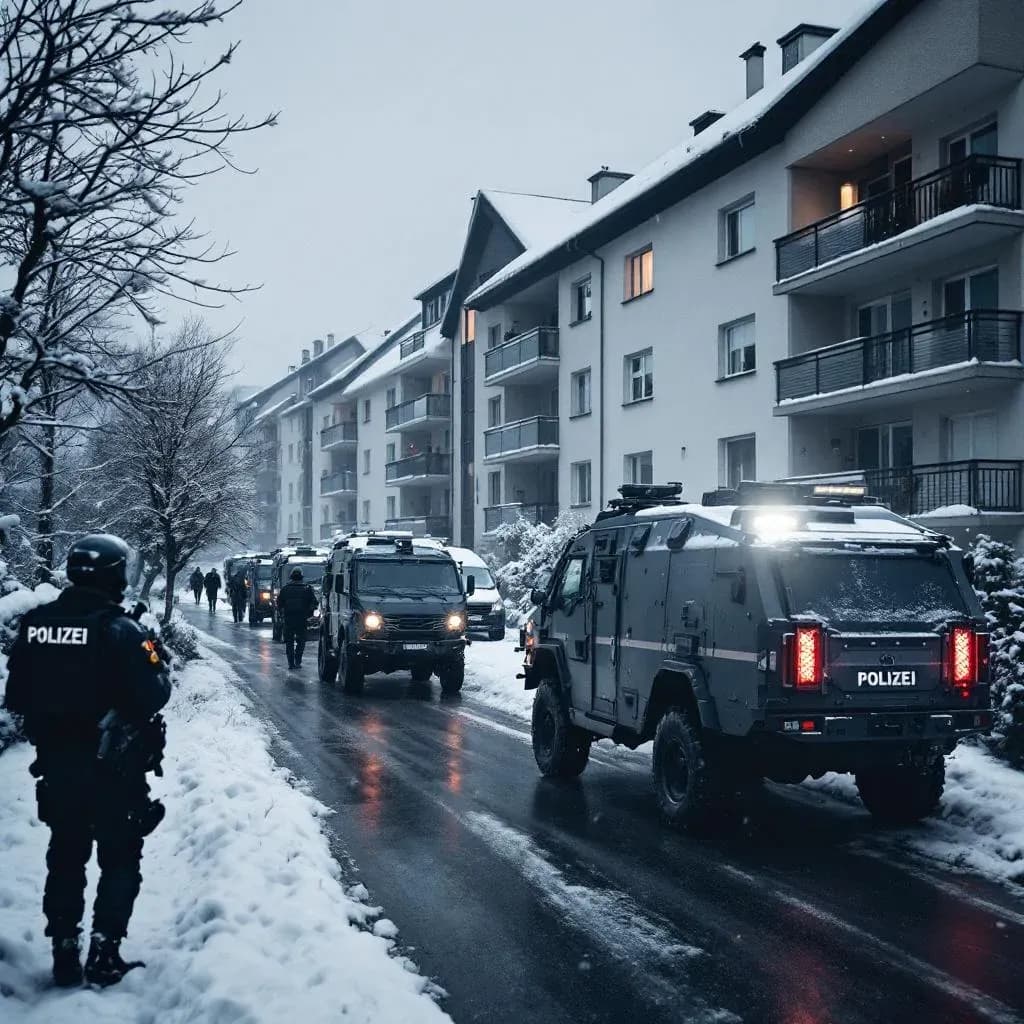
In December 2022, German intelligence services and police uncovered an extensive plan for an armed coup against the German state. The operation, dubbed "Operation Limes," resulted in the arrest of 25 people across multiple raids conducted between December 3-7, 2022. The group consisted primarily of members and supporters of the Reichsbürger movement—a right-wing extremist, anti-state movement with more than 20,000 members in Germany.
The Reichsbürger movement refuses to recognize the legitimacy of the Federal Republic of Germany and claims that the German Reich from before 1945 still exists as a legal entity. Members view themselves as citizens of a fictional state formation and reject German legislation and the legal system.
Timeline
3 December 2022
Beginn der Razzien
Das Bundeskriminalamt und die deutsche Polizei beginnen koordinierte Razzien gegen die Reichsbürger-Gruppe an mehreren Orten in Deutschland.
7 December 2022
Letzte Verhaftungen durchgeführt
Die umfassenden Razzien werden abgeschlossen. Insgesamt werden 25 Personen wegen ihrer Rolle in dem Putschplan verhaftet.
1 June 2023
Anklage erhoben
Die Staatsanwaltschaft erhebt offiziell Anklage gegen Heinrich XIII. und mehrere Hauptbeschuldigte wegen Hochverrats und Vorbereitung eines bewaffneten Staatsstreichs.
12 February 2024
Prozessbeginn
Der Prozess gegen die Hauptangeklagten beginnt vor dem Oberlandesgericht München mit Heinrich XIII. als Hauptangeklagtem.
29 August 2024
Erstes Urteil gesprochen
Das Münchner Gericht spricht ein erstes Urteil: Heinrich XIII. und Mitangeklagte werden wegen Hochverrats und Vorbereitung eines bewaffneten Putschversuchs zu langjährigen Haftstrafen verurteilt.
Group Leadership and Structure
The plan was led by Heinrich XIII, who uses the full name Heinrich XIII Prinz Reuß. He is a 71-year-old retired legal advisor who positioned himself as leader of the intended new government. Another key member was Birgit Malsack-Winkemann, a former CDU politician and member of the Bundestag from 2017-2021, who was to assume the role of foreign minister in the planned regime.
The group also included active and former military personnel, economists, and technology specialists. Several members had acquired military experience, indicating plans for armed action. The network extended across Germany with nodes in multiple federal states.
The Coup Plan
Intelligence services uncovered a concrete military plan for the coup attempt. The group had:
- Expressed intent to invade the Bundestag (parliament) with armed force
- Planned the arrest of members of the federal government
- Attempted to establish connections with right-wing militias and other extremist groups
- Sought contact with Russian military circles for potential support
- Accumulated weapons and military equipment
The plan appeared naive and more poorly organized than many superficial analyses initially suggested. The group lacked realistic strategies for establishing state control or sustaining such control for any length of time. Their will was present—the realism of their planning was questionable.
The Arrest Operation
Police and the Bundeskriminalamt (BKA) conducted large-scale coordinated raids at multiple locations. The operation was described as one of the largest against right-wing extremism since World War II. The 25 arrested included retired military officers, active soldiers, business people, and politicians from various social backgrounds.
The arrests received extensive public attention in Germany and internationally. The case highlighted concerns about right-wing extremism and anti-state movements in Germany.
The trial against the primary defendants began in February 2024 at the Munich Higher Regional Court (Oberlandesgericht München). Heinrich XIII and several others are charged with high treason and preparation for armed coup. German right-wing extremism was placed in focus as an escalating threat.
The case has attracted international attention as an example of anti-state, right-wing extremist activism in Germany. Coup attempts and anti-state movements are now discussed on the agendas of European security authorities.
Significance for German Security
The Reichsbürger operation underscores Germany's vulnerability to domestic extremism. Although the plan was less sophisticated than traditional military coups, it demonstrates the risks of armed violence and state overthrow from right-wing extremist networks. Bundeskriminalamt operations also revealed how former military experience among members could pose a genuine threat.
The movement continues to grow and has been classified as right-wing extremist by German security authorities. Raids against Reichsbürger members continue regularly.