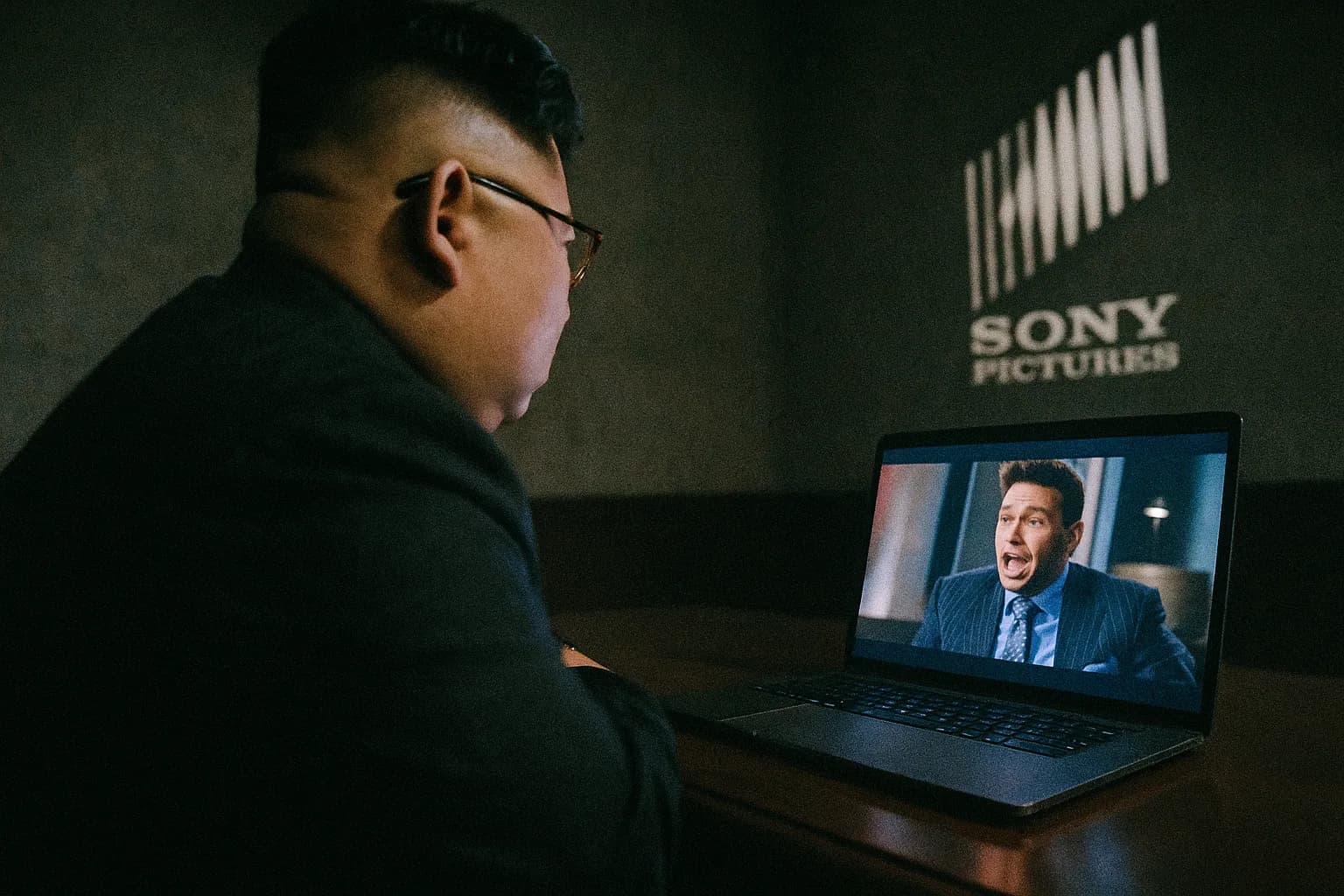
In late November 2014, North Korean state-sponsored hackers launched one of the most devastating cyber attacks in history against Sony Pictures Entertainment. The breach exposed approximately 38 million files—including 170,000 employee emails, thousands of Social Security numbers, unreleased films, and sensitive executive communications—and crippled Sony's computer systems with malware designed to destroy data.
The attack was a direct response to Sony's production and planned theatrical release of *The Interview*, a comedy film depicting an assassination attempt on North Korean leader Kim Jong Un. North Korea had condemned the film as "an act of terrorism" and "war" after the teaser trailer's release in June 2014. By December 8, hackers claiming to represent a group called the "Guardians of Peace" (GOP) issued explicit threats, warning of 9/11-style attacks on theaters that showed the film and beginning to leak stolen data.
The infiltration itself had begun months earlier, in July 2014, with hackers slowly stealing data before launching the full public attack on November 24. The timing and coordination suggested nation-state involvement rather than independent cybercriminals. U.S. intelligence agencies quickly mobilized to investigate.
Timeline
1 January 2014
Cyberangriff auf Sony Pictures
Hacker stehlen rund 100 Terabyte Daten vom Unterhaltungskonzern Sony Pictures Entertainment. Der genaue Zeitpunkt im Jahr 2014 ist nicht dokumentiert.
2 January 2014
USA beschuldigen Nordkorea
Die US-Regierung macht Nordkorea für den Angriff verantwortlich und sieht einen Zusammenhang mit dem Film 'The Interview' über Kim Jong-un.
3 January 2014
Experten äußern Zweifel
Sicherheitsexperten und ehemalige Hacker wie Hector Monsegur bezweifeln die Beweislage gegen Nordkorea. Wired Magazine berichtet über schwache Indizien.
On December 19, 2014, the FBI formally attributed the hack to the North Korean government—the first time the United States publicly blamed a nation-state for a cyber attack. The NSA assisted in the attribution through malware analysis and network tracing, aided by the agency's prior 2010 intrusion into North Korean networks. Both agencies noted that the hackers had been careless, using proxy IP addresses originating in North Korea, a critical oversight that helped confirm the connection.
North Korea denied any involvement, but U.S. officials, including FBI Director James Comey and NSA Director Admiral Michael S. Rogers, presented technical evidence linking the GOP to North Korean state actors.
The breach had immediate and chilling consequences. Faced with the threats, Sony initially canceled the theatrical release of *The Interview* entirely. This capitulation to threats sparked widespread criticism as an act of self-censorship, with many arguing that the company had surrendered core principles of free expression. However, *The Interview* eventually reached audiences through limited theatrical screenings and online platforms.
The attack also revealed what Sony executives had been discussing privately: internal emails showed that before the hack, Sony leadership—including Chairman Kazuo Hirai, CEO Michael Lynton, and co-chair Amy Pascal—had discussed softening the film's content to avoid angering North Korea. The hack exposed not only Sony's vulnerability to cyber attacks but also the willingness of major corporations to self-censor under pressure.
President Obama condemned the attack and vowed retaliation, promising responses both economic and diplomatic. The State Department issued a formal condemnation. The incident sent shockwaves through Silicon Valley and Hollywood, demonstrating that even large, well-resourced companies were vulnerable to sophisticated nation-state cyber operations.
The Sony hack became a watershed moment in cybersecurity and free speech debates. It illustrated how cyber threats could directly undermine First Amendment protections by compromising privacy, enabling , and intimidating media companies into editorial decisions. The attack raised urgent questions about government responsibility to protect critical infrastructure, corporate cybersecurity practices, and the boundary between national security and free expression—questions that remain contested today.