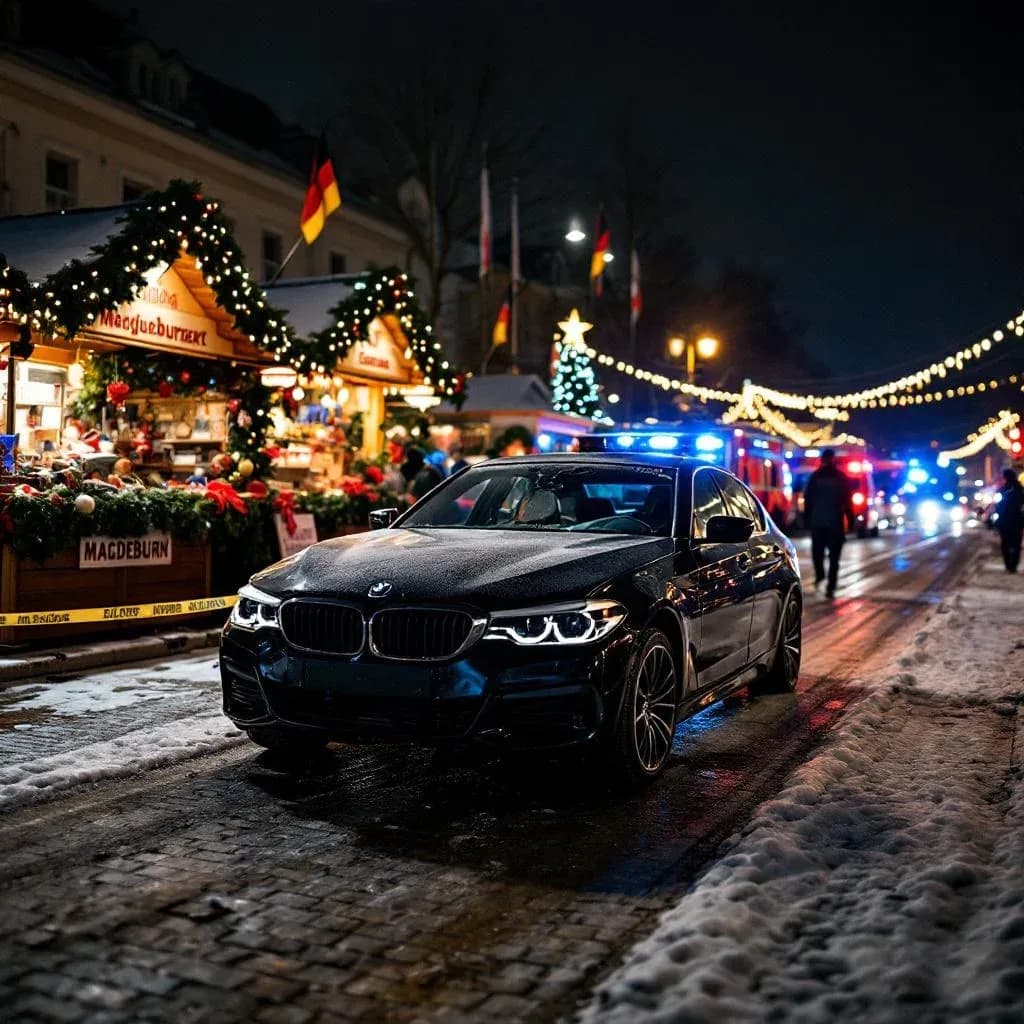
On 20 December 2024, one of Germany's worst terrorist attacks on a public space took place at the Christmas market in Magdeburg, a city in Saxony-Anhalt. A man got behind the wheel of a black BMW and accelerated directly into the densely packed crowd celebrating the holiday season among market stalls and festive lights.
The attack lasted only a matter of seconds, but left behind a scene of chaos, blood and despair. The vehicle continued its destructive path through the market, striking and killing people of all ages. Police arrived quickly and stopped the perpetrator before he could cause further harm.
Timeline
20 December 2024
Der Anschlag
Ein schwarzer BMW rast in die Menschenmenge auf dem Magdeburger Weihnachtsmarkt. Der Anschlag fordert fünf Todesopfer und über 200 Verletzte. Der Täter wird am Tatort festgenommen.
20 December 2024
Polizeieinsatz
Polizeikräfte treffen innerhalb weniger Minuten am Tatort ein. Der Täter wird gestoppt und festgenommen. Das Gebiet wird abgesperrt und die Ermittlungen beginnen sofort.
21 December 2024
Identifizierung der Opfer
Die fünf Todesopfer werden identifiziert. Über 200 Verletzte befinden sich weiterhin in Behandlung in Krankenhäusern der Region.
22 December 2024
Erste Haftvorführung
Der Täter wird dem Haftrichter vorgeführt. Gegen ihn werden schwere Vorwürfe erhoben, darunter Mord und versuchter Mord.
23 December 2024
Nationale Trauerbekundungen
Die Bundesregierung, Kirchen und gesellschaftliche Organisationen halten Gedenkgottesdienste und Trauerveranstaltungen für die Opfer ab.
The Victims
A total of 6 people were killed in the attack and more than 300 were injured. Among the dead were children, adults and elderly individuals. Many of those injured sustained life-threatening wounds and were treated at nearby hospitals. Identification of the victims began immediately after the attack.
The anguish of bereaved families was documented in the media, as desperate people searched for their loved ones among the injured at hospitals across the city.
The Perpetrator
The perpetrator was identified as a man whose motives became the subject of an extensive investigation. Authorities examined whether the attack had been driven by political extremism or personal grievance. He was arrested at the scene and charged with terrorism and murder.
In the days following the attack, the perpetrator was questioned by police, and investigators combed through his digital footprint, social media activity and prior contacts in an effort to understand the motivation behind the brutal killings.
German authorities launched a comprehensive investigation that included:
- Securing CCTV footage from the area surrounding the Christmas market
- Interviewing witnesses who had seen the attack or its immediate aftermath
- Analysing the vehicle and any relevant mechanical or technical factors
- Examining the perpetrator's personal background, social network and prior records
- Cooperating with security agencies across Germany
Police were particularly focused on establishing whether the perpetrator had a history of mental illness or had been exposed to extremist propaganda.
Reactions and Consequences
The attack shocked Germany and the wider world. Chancellor Olaf Scholz visited the site and expressed his profound grief. Crowds of people laid flowers and lit candles at makeshift memorials for the victims.
The attack raised urgent questions about security measures at public gatherings and Christmas markets, particularly in light of previous terrorist attacks on German Christmas markets, such as the one in Berlin in 2016.
German society and the government were confronted with difficult conversations about prevention, integration and the handling of threatening behaviour before it escalates into violence.
Legal Proceedings
The perpetrator was brought before the courts on charges of murder, attempted murder and possible terrorism-related offences. His case was to be heard by the German legal system, which sought both to establish his motivation and to ensure appropriate punishment.
The proceedings were followed intensively by the German and international press, and the case became a test of how societies respond to extreme violence in public spaces.