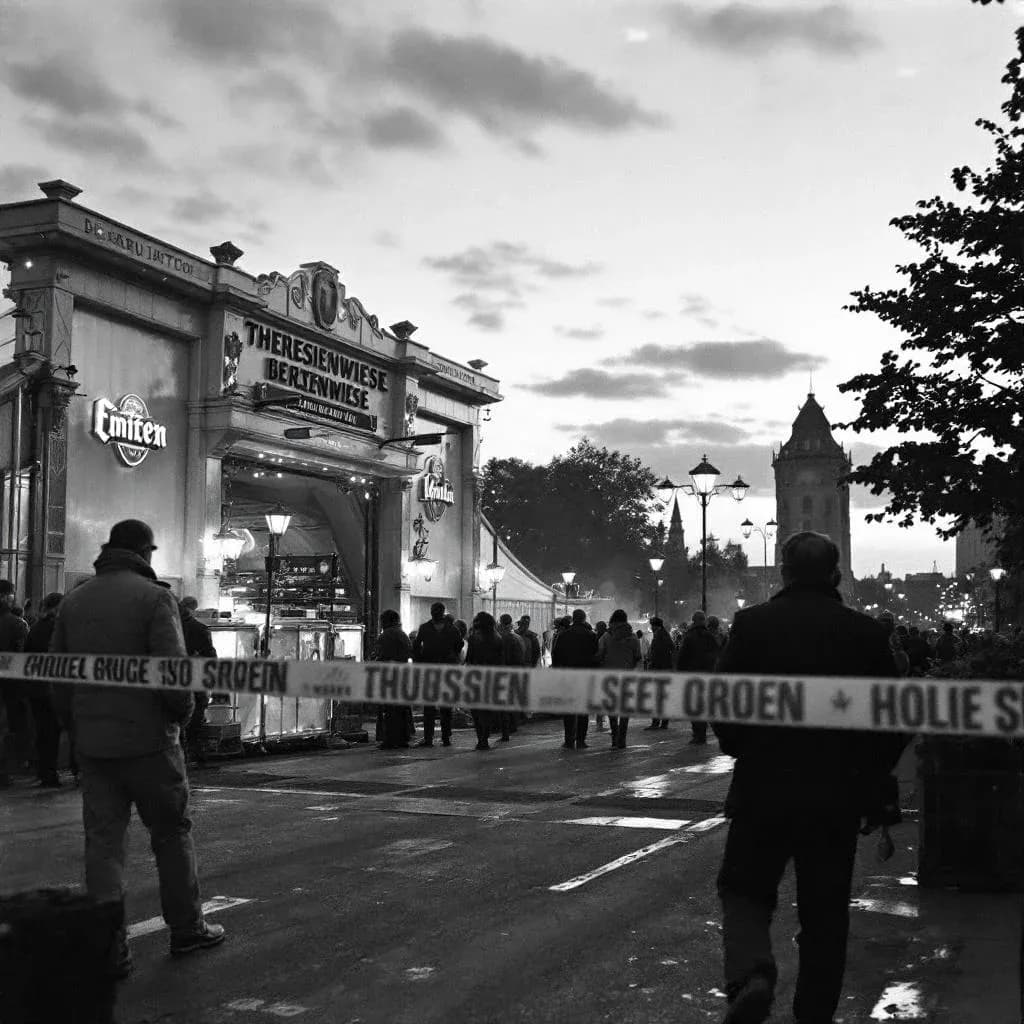
On 26 September 1980, Oktoberfest was approaching its annual peak beneath a clear Bavarian sky. At around 7:20 in the evening, thousands of festival-goers were moving through the Theresienwiese grounds, where the festival has been held since 1810. A metal pipe packed with nails and explosives was detonated at the entrance to the site. The blast was enormous, destroying everything in its immediate vicinity.
The 13 victims included 11 festival-goers and 2 police officers. Among the dead were children, young people and elderly visitors. More than 200 people were wounded — many of them seriously. Approximately 70 of the injured were under the age of 16. It was one of the worst terrorist attacks in West Germany's twentieth-century history.
Timeline
26 September 1980
Die Explosion
Um 22:19 Uhr detoniert am Haupteingang des Oktoberfests eine Bombe. 13 Menschen sterben, über 200 werden verletzt. Das Fest wird sofort abgebrochen.
27 September 1980
Identifizierung des mutmaßlichen Täters
Die Überreste des Bombenlegers werden als Gundolf Köhler (21) identifiziert. Er starb bei der Explosion. Erste Hinweise auf rechtsextreme Verbindungen tauchen auf.
15 October 1980
Intensivierung der Ermittlungen
Eine Sonderkommission der Polei untersucht Köhlers Umfeld und mögliche Mittäter. Die Wehrsportgruppe Hoffmann gerät in den Fokus.
30 June 1981
Ermittlungen im rechtsextremen Milieu
Die Bundesanwaltschaft konzentriert sich auf Verbindungen zu neonazistischen Netzwerken. Trotz Verdachtsmomenten werden keine weiteren Personen angeklagt.
31 December 1982
Einstellung des Verfahrens
Die Bundesanwaltschaft stellt die Ermittlungen offiziell ein. Köhler wird als Einzeltäter eingestuft – eine Entscheidung, die heftig kritisiert wird.
26 September 2020
Neue Dokumente veröffentlicht
40 Jahre nach dem Anschlag werden bisher geheime Akten freigegeben. Angehörige und Experten fordern eine vollständige Neuaufarbeitung des Falls.
German authorities launched a massive investigation. Forensic examiners were quickly able to determine that the bomb had been placed by a person who was killed in the blast. The remains were identified as those of Gundolf Köhler, a 21-year-old man with ties to far-right extremist circles.
Köhler had been a member of, or had expressed sympathies toward, far-right extremism in Germany and militant neo-Nazi groups. He had previously been arrested for minor offences and had been under police surveillance. His motives and any potential accomplices became the subject of intensive scrutiny.
It was never fully established, however, whether Köhler had acted alone or as part of a larger network. The investigation pointed to possible connections with far-right organisations, but the evidence was never sufficient to bring charges against any other individuals. Theories about state involvement — including from German intelligence services and potential foreign actors — circulated for years afterward.
Political Context and Conspiracy Theories
The timing of the attack was significant. Germany was in the midst of a period in which far-right and far-left groups were especially active, against a backdrop of heightened global tensions during the Cold War.
A number of conspiracy theories emerged around the attack. Some held that West German and East German intelligence services had been involved. Others pointed to neo-Nazi networks seeking to destabilise Germany. A grouping referred to as the "Oktoberfest group" was examined by authorities.
Köhler's death meant that no criminal could ever be held. Investigative mandates were wound down and case files were gradually closed. In 2020 — forty years after the attack — certain parts of the inquiry were nevertheless reopened after new documents were declassified.
The 1980 Oktoberfest bombing became a turning point in German security policy. The festival subsequently received significantly enhanced security measures, and counter-terrorism preparedness was elevated as a national priority.
For the victims' families, it became a grief process without resolution. Without a complete legal outcome or full judicial accountability, any sense of closure remained out of reach. The years that followed were marked by speculation and questions that have never been fully answered.
The case belongs to that category of unsolved or only partially resolved political and terrorist attacks in which the identity of the direct perpetrator was established, but the broader picture — the motives, the coordination and any wider conspiracies — remained unclear. It endures as a dark chapter in modern European history.